USAID DEC
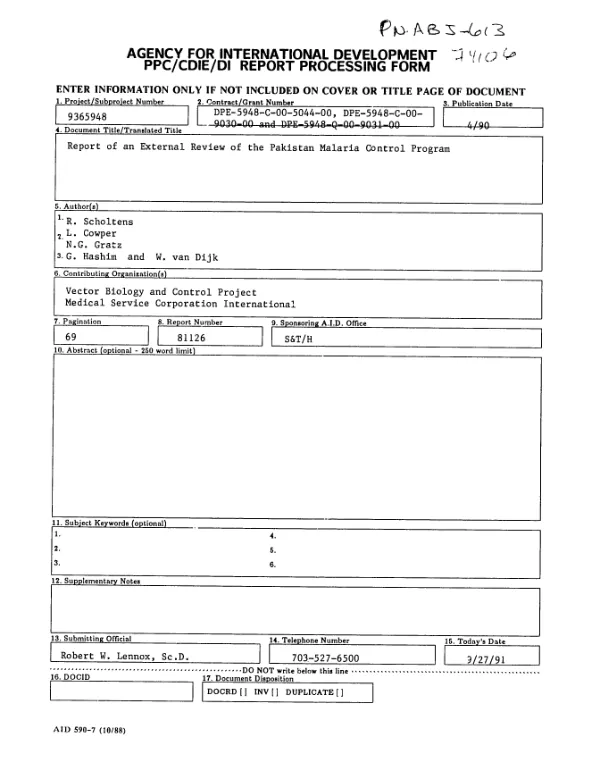
Report of an external review of the Pakistan malaria control program : Islamabad, March 4-26 1990
Sign inMEDICAL SERVICE CORP. INTERNATIONAL
Report of an external review of the Pakistan malaria control program : Islamabad, March 4-26 1990
Evaluates Pakistan's A.I.D.-assisted Malaria Control Program (MCP).
Scholtens, R.|Cowper, L. · 1989
Sign in to readA free account is required to download.
Abstract
The review was conducted in two stages. First, an insecticide resistance expert visited Pakistan 1/14-19/90. Later, a team of malaria specialists from the Vector Biology and Control Project, WHO and the Government of Pakistan worked with officials and staff at facilities of the MCP and General Health Services (GHS) 3/4-26/90. The team found four very different provincial programs, with adequate coordination and training support but less than adequate operational research capabilities. Integration of malaria control into the GHS, so far as it has gone, has strengthened the MCP by granting it a degree of stability and permanence, but has weakened its once formidable discipline, direction, and operational resources. MCP activities in Punjab are relatively strong and successful, but technical, administrative and security problems impair performance to a greater degree in Northwest Frontier Province (NWFP), Sindh, and Baluchistan. The malaria surveillance effort remains substantial. Annual reported cases increased from 59,386 in 1988 to 104,447 in 1989, due partly to a continuing shift from active case detection (ACD) to passive case detection (PCD), which produces fewer blood slides from those who have had a recent fever and more from those with a current fever. In 1989, 22.3% of all slides came from PCD, an increase of 5% since 1988. But the rising number of malaria cases is also due to increased incidence because 9.03% of all 1989 PCD slides were positive, compared to 5.76% in 1988. This is troubling, particularly because falciparum malaria increased from 37% to 53% of all cases. The total number of malaria cases and number of falciparum cases increased dramatically in Sindh, markedly in Punjab and NWFP, and decreased slightly in Baluchistan. Falciparum malaria cases occurred mostly in the Sindh and adjacent areas in Punjab and Baluchistan. Because of increasing evidence of chloroquine-resistant falciparum malaria at the regional and national levels, and because chloroquine is given to each suspected case of malaria in the country, drug resistance should be considered a possible cause of this dramatic rise in falciparum malaria. The other resistance problem is the potential impact of the widespread resistance of Anopheles stephensi to malathion, which was documented in January. The important field research necessary to determine the role of this species in malaria transmission in Pakistan remains incomplete. This evaluation team's considerable effort to relate disease surveillance findings to sites with known A. stephensi resistance produced no epidemiologic justification for any substantial replacement of malathion with fenitrothion. In 1989, just one house in 10 was sprayed with malathion to control malaria. Only houses in localities where malaria cases were most abundant were sprayed. They only received one application of malathion, whose residual effect may not exceed 30 days. This rather marginal control measure may have limited impact on disease transmission. The MCP strategy is to reduce dependence on insecticides while implementing alternative control measures. The reduction has occurred, but the alternative measures, which were to be identified through an active operational research program, have not been defined. We found the malaria control operational research capacity very limited and without much promise. For now, spraying residual insecticides remains the most cost-effective means of malaria control in Pakistan. Microscopy services have remained strong during this time of integration and decentralization. However, the planned tenfold expansion of microscopy services to provide services in each Basic Health Unit (BHU) seems excessive. The team's major recommendations are as follows. (1) Because of increased malaria incidence, spraying criteria should revert to those used in 1988. (2) Epidemiologic evidence does not justify the immediate use of fenitrothion in the Punjab, but supports its careful introduction in NWFP. (3) Research into critical operational issues, such as the vectorial capacity of A. stephensi, the extent and importance of vector resistance to malathion and of chloroquine-resistant falciparum malaria, and the usefulness of alternative control measures, must be conducted on a large scale if the MCP is ever to become sustainable without donor assistance. (Author abstract)