USAID DEC
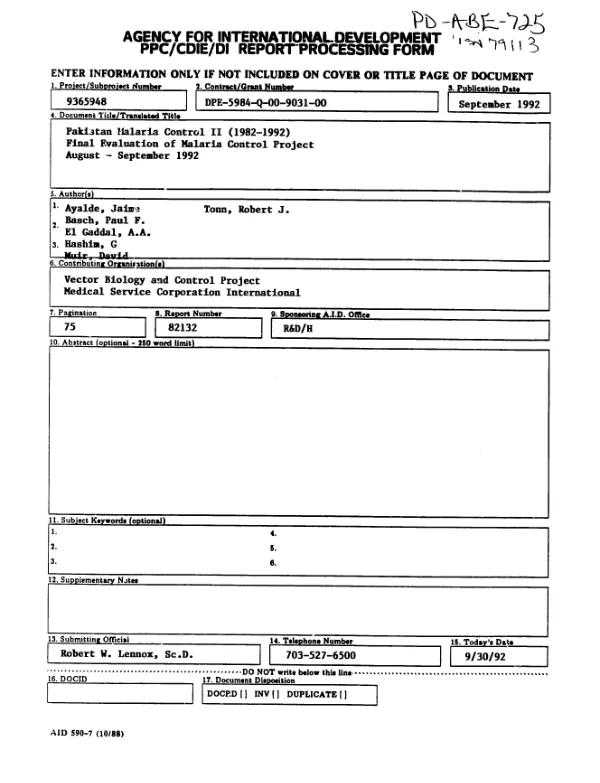
Pakistan malaria control II (1982-1992) : final evaluation of malaria control project, August - September 1992
Sign inMEDICAL SERVICE CORP. INTERNATIONAL
Pakistan malaria control II (1982-1992) : final evaluation of malaria control project, August - September 1992
During the life of the project malaria transmission has been contained at an acceptable level while insecticide usage was gradually reduced.
Ayalde, Jaime|Basch, Paul F. · 1992
Sign in to readA free account is required to download.
Abstract
The project has not reached the stated nationwide target of maintaining Annual Parasite Incidence (API) at or below 0.5 cases per 1,000 population, but reported an acceptable API of 0.89 for 1991, based on the rural population. In 1991 Punjab was the only province to maintain the incidence below 0.5 cases per 1,000, with a reported API of 0.3. The proportion of slides taken by passive case detection was 25% in 1991, an improvement from previous levels but well below the target. Experience has shown that the malaria situation in Pakistan deteriorates whenever external donor assistance ceases. The GOP must demonstrate increased self-reliance even as it seeks alternative sources of external funding for unavoidable imports such as insecticides, spare parts and other commodities, which it is estimated will cost about $5 million per year. As dependence on insecticide spraying is reduced, a new malaria control strategy must be based on better knowledge of the epidemiological situation. An information system must be developed which is sensitive enough to provide early warning of epidemics and to monitor the situation. Operational research must be given higher priority so that control efforts are focused on localities at highest risk. Studies must be conducted to gain an understanding of various risk factors. The role of Anopheles stephensi and other domestic anopheline mosquitoes in malaria transmission must be clarified. The transmission of Plasmodium falciparum must be carefully monitored, as this species now constitutes 40% of all malaria cases and chloroquine resistance is widespread. A reduction in the number of houses programmed for spraying has been gradually attained since 1988, in accordance with the adopted policies. The percentage of houses to be sprayed is already well below 25% of existing houses, without noticeable negative effect. The process of integrating malaria control into the health sector, which is under way, must be extended throughout the rural areas of all provinces of Pakistan, both to obtain information and to make diagnostic and treatment capabilities more widely available. The reduction in entomological surveillance is acceptable as long as emphasis is placed on increased case detection and treatment. However, as insecticide coverage is held level or increased, surveillance activities will need to be strengthened. Well-established malathion resistance in An. stephensi and the potential for increased resistance in the primary vector, An. culicifacies, present serious problems. Because of the diminishing efficacy of malathion, routine insecticide susceptibility testing must be increased, and extended to other classes of insecticides that may be required in the future. The cost-effectiveness of any new insecticide should not be calculated on cost per ton or per applied area, but expressed in terms of reduction of transmission in comparison with malathion. For this analysis, detailed epidemiological and operations research is essential. There is a need to provide better career opportunities to malaria control staff. Some senior staff posts remain vacant and few young people are available. With the termination of donor support, malaria control operations face many difficulties, but the staff problem must be given high priority. Intersectoral coordination must be established with agriculture, irrigation, education, and other relevant areas of national and provincial governments. Links should also be established with academic institutions. The team believes that under the present conditions -- GOP budget cuts, withdrawal of donor funds, and increased rainfall and flooding -- the GOP will find it difficult to sustain an effective malaria control program. (Author abstract)
Related documents