USAID DEC
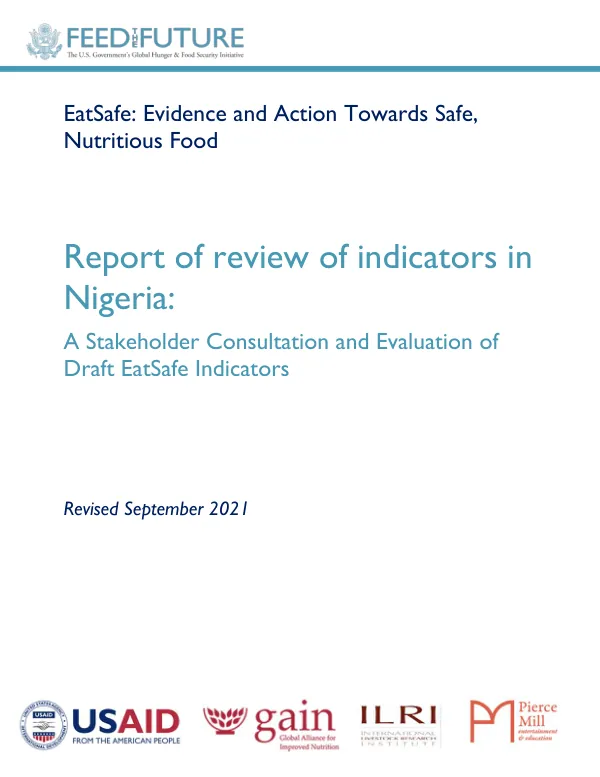
Report of review of indicators in Nigeria: A Stakeholder Consultation and Evaluation of Draft EatSafe Indicators
Sign inFEED THE FUTURE
Report of review of indicators in Nigeria: A Stakeholder Consultation and Evaluation of Draft EatSafe Indicators
The EatSafe: Evidence and Action Towards Safe, Nutritious Food initiative aims to improve the safety of nutritious foods in informal market settings.
2021 · 21 pages
Sign in to readA free account is required to download.
Abstract
The project has three objectives and three corresponding expected results over two phases. The objectives are to consolidate and generate knowledge and evidence about consumer values and perceptions related to food safety, gender roles and norms that may influence food-related behavior, and quantified food safety risks in informal markets. During Phase I, EatSafe monitored a set of custom indicators to track the generation and dissemination of new evidence on food safety in traditional markets. However, as the project moves into Phase II, new indicators are needed to assess the impact of interventions on consumer and vendor awareness, beliefs, and actions related to food safety. A global exercise was conducted to identify potential custom indicators for EatSafe to use during the testing of interventions. Two stakeholder workshops were convened in Abuja and Birnin Kebbi, Nigeria, to solicit views on each custom indicator. The indicators were assessed collectively to decide whether they were adaptable to the EatSafe project, should be modified, or reserved for future discussion and consideration. In Abuja, eight of the eleven EatSafe custom indicators were recommended as suitable for use with few modifications made, while the remaining three were reserved for future discussions and consideration. At the Kebbi meeting, six out of the eleven EatSafe custom indicators were recommended as suitable for use, and two additional indicators were suggested by the stakeholders. Overall, six indicators were supported by stakeholders in both Kebbi and Abuja as custom indicators for Phase II of the EatSafe program in Nigeria. The recommended indicators include consumer knowledge, feelings, and attitudes related to food safety, as well as vendor knowledge and attitudes related to food safety. The indicators will be used to assess the impact of interventions on consumer and vendor awareness, beliefs, and actions related to food safety. The EatSafe Phase II indicators will focus on the impact of interventions chosen for use in Kebbi State, Nigeria, to change consumer and/or vendor awareness, beliefs, and actions related to food safety. Information gleaned from the custom indicators can be used to make recommendations about which interventions should be scaled up or replicated elsewhere and to improve intervention design in future EatSafe countries. The EatSafe project will continue to work with stakeholders to refine the indicators and ensure that they are adaptable to the project's needs. The project's goal is to generate evidence that will help engage and empower consumers and market actors to better obtain safe, nutritious food. The recommended indicators for Phase II of the EatSafe program in Nigeria include: - Consumer knowledge: Percent of consumers who mention food safety as a concern when asked what they consider when shopping for food - Consumer feelings and attitudes: Percent of consumers who rank food safety as "important" or "very important" - Consumer behavior: Percent of consumers who report having chosen one type of food/product over another because they thought it was safer - Vendor knowledge: Percent of vendors who report that food safety is an important consideration in selecting suppliers - Vendor feelings and attitudes: Percent of vendors who report they have an important role in assuring food safety for the products they sell - Vendor behavior: Percent of vendors who report discussing food safety with their suppliers These indicators will be used to assess the impact of interventions on consumer and vendor awareness, beliefs, and actions related to food safety. The project's goal is to generate evidence that will help engage and empower consumers and market actors to better obtain safe, nutritious food.
Related documents
![Community Improved Sanitation Coverage and Childhood Stunting (SAR23) - Analysis Brief [AB31]](https://covers.devme.ai/gen/146599.webp)