USAID DEC
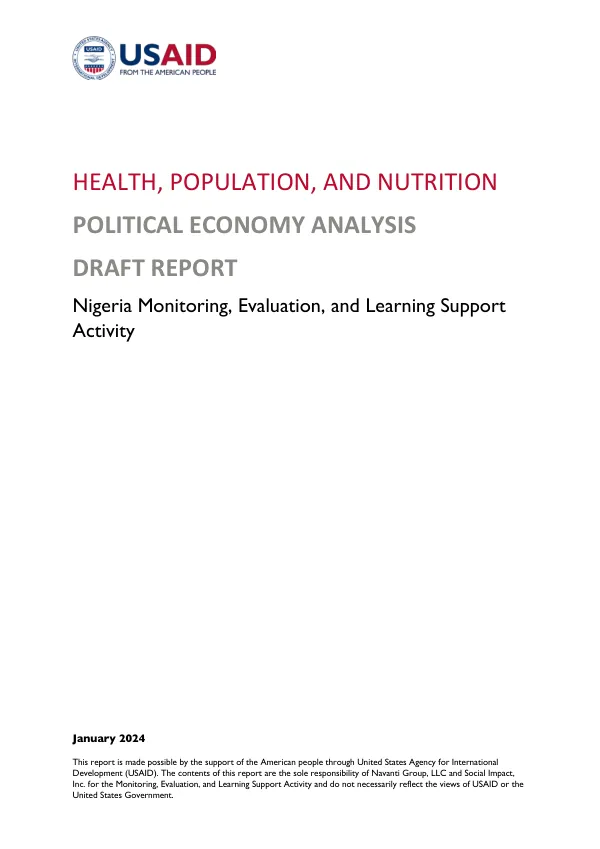
Health, Population, and Nutrition: Health Applied Political Economy Analysis in Nigeria
Sign inSOCIAL IMPACT, INC.
Health, Population, and Nutrition: Health Applied Political Economy Analysis in Nigeria
Health Financing in Nigeria is heavily dependent on government priorities, which are documented in the Medium-Term Expenditure Framework (MTEF).
2024 · 54 pages
Sign in to readA free account is required to download.
Abstract
The MTEF development phase is an important phase where external stakeholders can advocate for the inclusion of health as a government priority. However, the lack of data used in advocacy for health sector issues is one major challenge in pushing for governance reforms to improve health funding. To increase health funding and ensure effective implementation, it is recommended that the State Ministries of Health build the capacity of their staff to generate and use evidence for effective advocacy. Human Resources for Health (HRH) in Nigeria face several challenges, including existing policies that affect HRH, HRH production, equitable distribution, retention, workforce performance, and roles of key stakeholders in HRH management. The Nursing and Midwifery Council of Nigeria (NMCN) is responsible for the regulation of nursing and midwifery practice in Nigeria. However, the council faces challenges in enforcing its regulations due to inadequate funding and infrastructure. To address these challenges, it is recommended that the NMCN receives adequate funding and support to enable it to effectively regulate the nursing and midwifery profession. Transparency and accountability in the health sector in Nigeria are critical for ensuring that resources are used effectively and efficiently. The Nigeria Health Sector Accountability Structure is responsible for ensuring transparency and accountability in the health sector. However, the structure faces several challenges, including inadequate funding and infrastructure. To address these challenges, it is recommended that the structure receives adequate funding and support to enable it to effectively ensure transparency and accountability in the health sector. The assessment was conducted using desk review and key informant interviews (KIIs) for primary qualitative data collection. Thirty KIIs were conducted with respondents from six states (Akwa Ibom, Bauchi, Ebonyi, Lagos, and Sokoto States, as well as the Federal Capital Territory [FCT]), including USAID Nigeria staff. The USAID team purposively selected these states to give a country-wide perspective on the three focus areas (one from each geopolitical zone of the country) and because of current program implementation in these states. The findings of this assessment have several implications for the health sector in Nigeria. Firstly, the assessment highlights the need for improved health financing in Nigeria. The lack of data used in advocacy for health sector issues is a major challenge in pushing for governance reforms to improve health funding. To address this challenge, it is recommended that the State Ministries of Health build the capacity of their staff to generate and use evidence for effective advocacy. Secondly, the assessment highlights the need for improved HRH in Nigeria. The existing policies that affect HRH, HRH production, equitable distribution, retention, workforce performance, and roles of key stakeholders in HRH management are major challenges that need to be addressed. To address these challenges, it is recommended that the NMCN receives adequate funding and support to enable it to effectively regulate the nursing and midwifery profession. In conclusion, the findings of this assessment have several implications for the health sector in Nigeria. The assessment highlights the need for improved health financing, HRH, and transparency and accountability in the health sector. To address these challenges, it is recommended that the State Ministries of Health build the capacity of their staff to generate and use evidence for effective advocacy, the NMCN receives adequate funding and support to enable it to effectively regulate the nursing and midwifery profession, and the Nigeria Health Sector Accountability Structure receives adequate funding and support to enable it to effectively ensure transparency and accountability in the health sector.
![Community Improved Sanitation Coverage and Childhood Stunting (SAR23) - Analysis Brief [AB31]](https://covers.devme.ai/gen/146599.webp)