USAID DEC
REPORT OF REVIEW TEAM ON BIOLOGICAL NITROGEN FIXATION SYMBIOTIC PROJECT (NIFTAL)
Evaluates project to reduce LDC dependence on nitrogen fertilizers through use of nitrogen fixation by tropical legumes.
POPENOE, HUGH|HANKINS, ALLEN C. · 1979
Sign in to readA free account is required to download.
Abstract
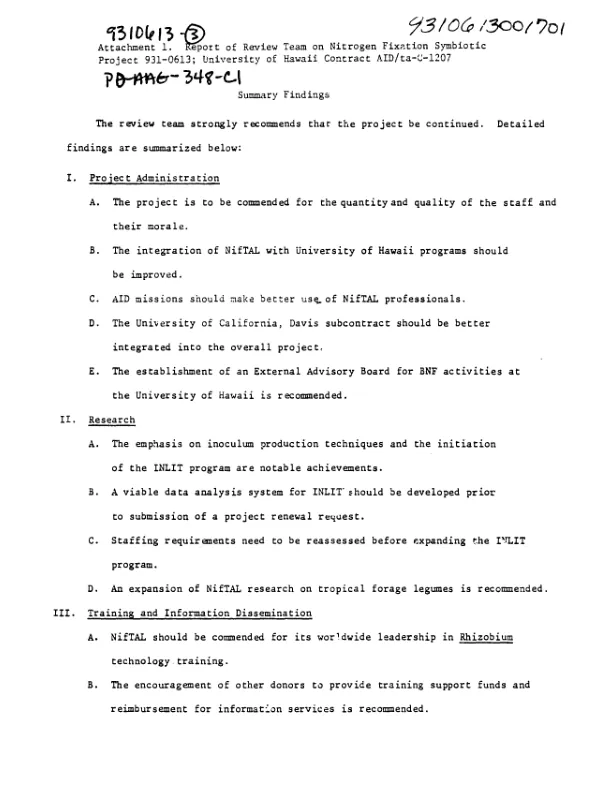
This special evaluation, which is attached to a PES (PD-AAG-348-B1), covers the period 2/77-7/80 and is based on interviews with project staff and visits to research sites. Biological Nitrogen Fixation Project (NifTAL) management and leadership have been commendable, along with the scientific competence and enthusiasm demonstrated by the staff. NifTAL activities at the University of Hawaii (UH) are not well-integrated with UH's programs. Some 1,493 "Rhizobium" isolates from 83 legume species were collected for NifTAL and LDC research. The isolates are being used for the International Network of Legume Inoculation Trials (INLIC) which test promising strains under various conditions (i.e., when stored under high temperatures). INLIC also verifies data from research conducted under subcontract at the University of California (UC) on the tolerance of "Rhizobium" strains to soil stress factors. A system for processing data compiled through INLIC has not yet been developed. Small-scale, low-cost inoculant production systems have been developed. However, since these systems utilize pre-sterilized peat inoculants, their applicability is reduced in LDC's lacking suitable peat deposits. NifTAL has provided training in "Rhizobium" technology through short courses in LDC's, an intern program for scientists and technicians, and a graduate program. Documents have been assembled for use by staff, trainees, and clients abroad and 900 persons in 88 countries have exchanged information with NifTAL. NifTAL's outreach is nevertheless hampered by lengthy operational procedures. It is recommended that NifTal be continued in an expanded research scope and integration of the project with UH programs and with the UC subcontract be improved; an External Advisory Board be established; a data analysis system for INLIT be developed; other donors provide training and information service funds; A.I.D. assist in improving information dissemination; and staffing be increased before expanding INLIT.