USAID. BUR. FOR DEVELOPMENT SUPPORT. OFC. OF AGRICULTURE
NITROGEN FIXATION - SYMBIOTIC, TROPICAL LEGUMES
Evaluates project to reduce LDC dependence on nitrogen fertilizers through expanded use of nitrogen fixation by tropical legumes.
FREDERICK, LLOYD R.; SIMKINS, CHARLES A. · 1981
Sign in to readA free account is required to download.
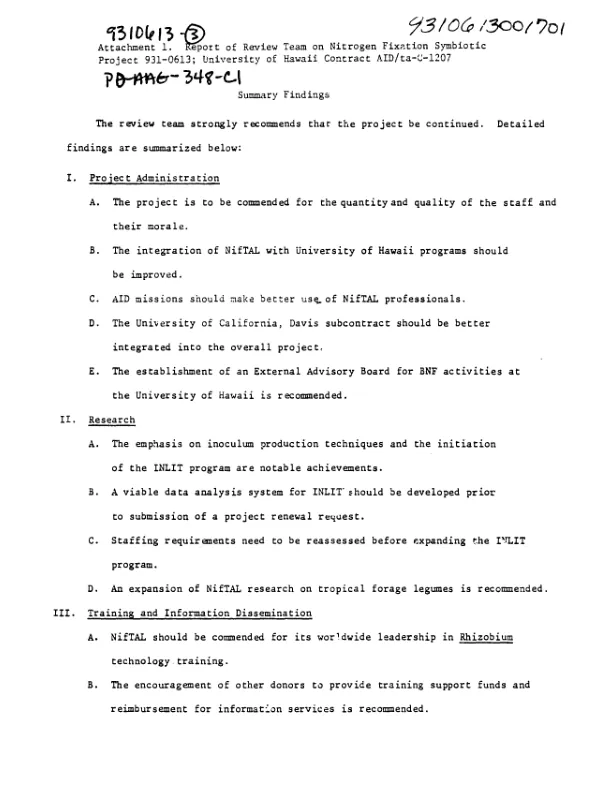
Abstract
Evaluation, attached to a special evaluation (PD-AAG-348-C1) on which it is based, covers the period 2/77-7/80. Despite primitive research facilities at the University of Hawaii (UH) and lack of contact with the UH"s main campus, progress has been made toward achieving outputs. A research team of microbiologists, agronomists, and graduate students was organized. Some 1,500 strains of "Rhizobium" were collected. Effective "Rhizobium" strains for 80 tropical legume species are available to LDC scientists. Three superior strains were identified for 13 major legumes. "Rhizobium" strains were also screened for tolerance to acid soils. Development and field testing of improved low-cost, small-scale inoculant production techniques have been emphasized, although less time has been spent on inoculum delivery techniques and on developing cultures exploiting nitrogen contribution by tropical legumes. Research has also been performed on the effects of phosphorus deficiency, shading, and intercropping on nitrogen fixation by tropical legumes. In general, research activities have required prioritization due to budgetary constraints. Short training courses in "Rhizobium" technology were conducted for 104 scientists in Hawaii, Kenya, Malaysia, and Brazil. Intern training was given to 13 LDC scientists in Hawaii. Project staff have participated in international conferences, visited scientists in LDC"s, and hosted workshops. Although fewer research publications were produced than expected, a quarterly Biological Nitrogen Fixation (BNF) Bulletin, a bibliography on BNF, and a newsletter reporting project activities are distributed worldwide. The International Network of Legume Inoculation Trials (in which legume inoculants are field-tested cooperatively by national scientists in their own countries to determine crop yield increases) have taken place at 80 locations in 30 LDC"s. It is recommended that the project be extended for 5 years.