USAID DEC
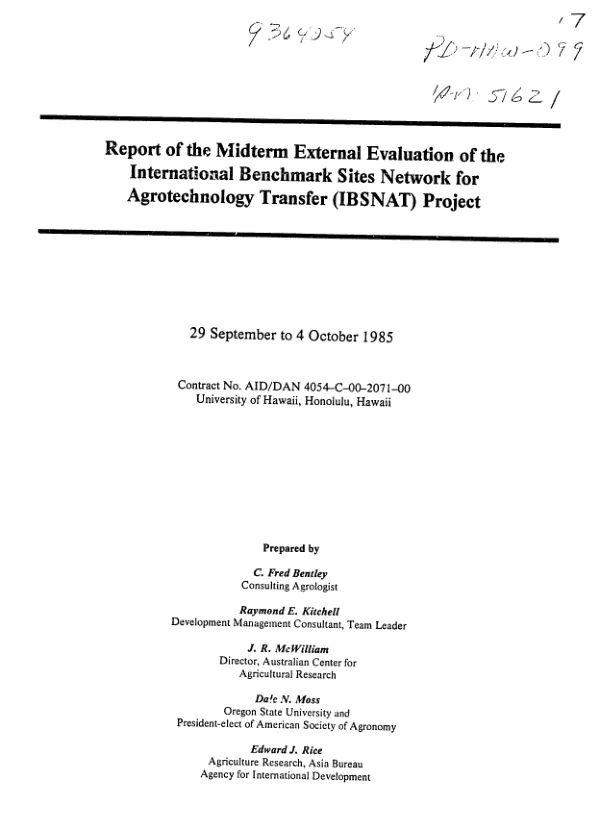
Report of the midterm external evaluation of the international benchmark sites network for agrotechnology transfer (IBSNAT) project ; 29 September to 4 October 1985
Sign inUNIVERSITY OF HAWAII AT MANOA. COLLEGE OF TROPICAL AGRICULTURE AND HUMAN RESOURCES. DEPT. OF AGRONOMY AND SOIL SCIENCE
Report of the midterm external evaluation of the international benchmark sites network for agrotechnology transfer (IBSNAT) project ; 29 September to 4 October 1985
Evaluates the International Benchmark Sites Network for Agrotechnology Transfer (IBSNAT) project to utilize computer technology to develop a systems approach for transferring agricultural technology.
Bentley, C. Fred|Kitchell, Raymond E. · 1985
Sign in to readA free account is required to download.
Abstract
Mid-term external evaluation covers the period 8/82-8/85 and is based on site visits and document review. Project performance overall has been very good. IBSNAT has procured a commercial database management system (DMS) and has identified the minimum data set (MDS) needed to verify and validate crop models using the DMS. The wheat, maize, and soybean models which existed prior to IBSNAT have been adapted to fit the DMS, while models for rice and sorghum are under development and should be operational in about a year. IBSNAT's modeling work has been outstanding, despite some negative factors: the crop models' failure to take diseases and insect damage into account; slow progress in developing cassava and other root crop models; and variability in the quality of the data received from collaborators. Also outstanding has been IBSNAT's work to develop networks of international collaborators; to date, 29 institutions (20 of which are in developing countries) are participating. However, it is very important that more training, case studies, and on-site applications be conducted to more fully develop the capabilities of the LDC collaborators. Information dissemination activities have been adequate; IBSNAT produces a variety of periodicals and other publications, but needs to produce more "user friendly" material that reaches non-technical audiences. IBSNAT management has been above average, though hampered by lack of control over the performance of collaborators, competing A.I.D. demands on staff time, and inadequate office space. Despite accelerating changes in systems analysis and information technology, IBSNAT's objectives remain valid. The probability of meeting these objectives is high if the project is extended to 1991. Other recommendations are to, inter alia: (1) improve data acquisition activities, (2) include disease and insect factors in crop models, and develop a model for millet; (3) provide hands-on training and TA to collaborators in MDS collection, experimental layouts, etc; (4) expand publication activities; (5) and establish a Management Review Group to guide IBSNAT strategic planning.
Related documents