USAID DEC
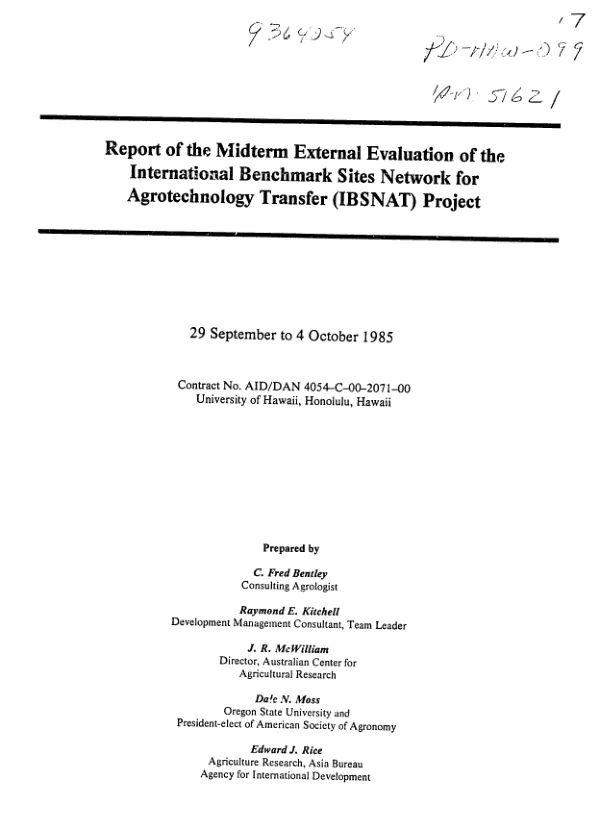
Report of the midterm external evaluation of the international benchmark sites network for agrotechnology transfer (IBSNAT) project, 9 July to 14 July 1990
Sign inINTERNATIONAL RESOURCES GROUP (IRG)
Report of the midterm external evaluation of the international benchmark sites network for agrotechnology transfer (IBSNAT) project, 9 July to 14 July 1990
Mid-term evaluation of a project to develop a prototype computer program to support agricultural research and decisionmaking in developing countries.
Bouma, Johan|Jensen, Ray · 1989
Sign in to readA free account is required to download.
Abstract
The University of Hawaii at Manoa is the implementing agency. External evaluation covers the period 9/87- 7/90. The project is well managed and highly productive. The cornerstone computer program, the Decision Support System for Agrotechnology Transfer (DSSAT) Version 2.1, has excellent documentation and has been distributed to 162 subscribers around the world. DSSAT combines soil, weather, and crop information to produce scientifically validated simulations of crop growth and yield; it currently includes four crops -- maize, soybean, wheat, and peanut -- with others in various stages of development. DSSAT has been used by policymakers to guide their decisionmaking and by research scientists to improve experimentation planning. In an unexpected application, the U.S. Environmental Protection Agency has used DSSAT to study global climate change. Still further applications, e.g., for evaluating sustainable agriculture, pest management strategies, etc., are likely. Planned additions to DSSAT include: (1) a socioeconomic dimension that will greatly assist in understanding on-farm choices and the consequences of policy decisions; (2) modules dealing with biological and physical constraints to crop growth; and (3) a multiple cropping/crop sequence module for small farm evaluations. The project's success is largely attributed to: (1) the high quality and commitment of scientific and technical staff, (2) the collaboration of scientists from around the world, and (3) its foresight in selecting a minimum data set for crop simulations. Several lessons were learned. (1) A successful project has a conceptual framework that is common to all participants, with stated and consistently applied goals. (2) A process-oriented approach is effective in conducting multidisciplinary research. (3) A working group is an effective means of extending a project's membership and enlisting the cooperation of other collaborators. (4) A network can serve as an effective clearinghouse of information and as a means for coordinating activities for a research project. (5) When a project has intensive data requirements, the minimum data set and the means for integration of disciplines should be defined early. (6) Open architecture computer programming allows replacement of individual modules which describe aspects of the overall program. (7) People will use quality products.