USAID DEC
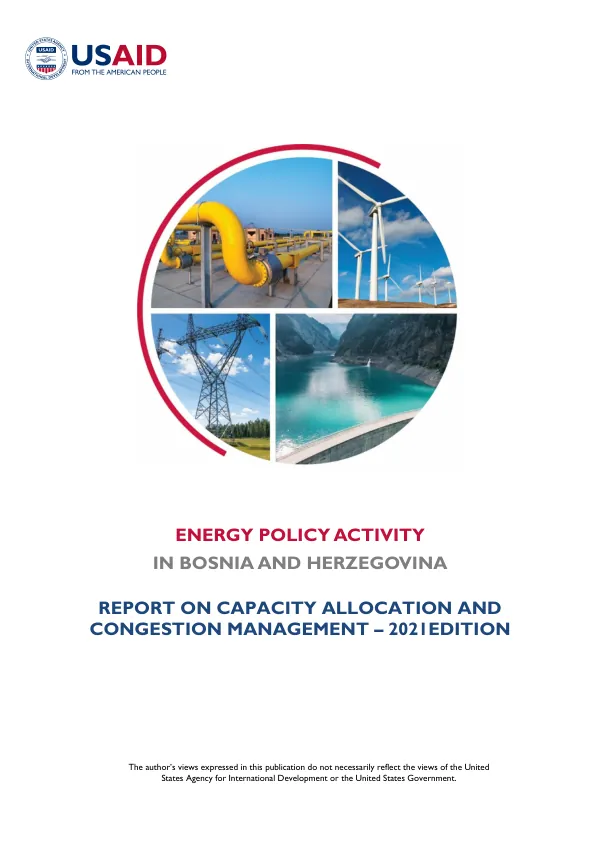
USAID Energy Policy Activity Report on Capacity Allocation and Congestion Management – 2nd Edition
Sign inADVANCED ENGINEERING ASSOCIATES INTERNATIONAL, INC. /SGGA
USAID Energy Policy Activity Report on Capacity Allocation and Congestion Management – 2nd Edition
Capacity allocation mechanisms and congestion management are crucial components of the natural gas regulatory framework in the European Union.
2021 · 59 pages
Sign in to readA free account is required to download.
Abstract
The EU's Third Energy Package introduced new rules for capacity allocation and congestion management, which are essential for ensuring a well-functioning internal market in natural gas. Capacity allocation refers to the process of allocating transport capacity to network users. This involves determining the amount of gas that can be transported through a particular pipeline or network. The capacity allocation mechanism is responsible for ensuring that capacity is allocated fairly and efficiently, taking into account the needs of all network users. Congestion management, on the other hand, refers to the process of managing congestion on the natural gas networks. Congestion occurs when the demand for gas exceeds the available capacity, leading to a reduction in the pressure and flow of gas through the network. Congestion management involves implementing measures to prevent or mitigate congestion, such as adjusting the capacity allocation mechanism or implementing emergency procedures. The EU's Third Energy Package introduced new rules for capacity allocation and congestion management, which are outlined in the 3rd Gas Directive and Regulation 715/2009. These rules require Member States to establish a capacity allocation mechanism and congestion management procedures that are based on the principles of transparency, non-discrimination, and fairness. The capacity allocation mechanism must ensure that capacity is allocated fairly and efficiently, taking into account the needs of all network users. This involves determining the amount of gas that can be transported through a particular pipeline or network, and allocating capacity to network users based on their needs and priorities. Congestion management procedures must be implemented to prevent or mitigate congestion on the natural gas networks. This involves adjusting the capacity allocation mechanism, implementing emergency procedures, and taking other measures to prevent or mitigate congestion. The EU's Third Energy Package also introduced new rules for the implementation of capacity allocation mechanisms and congestion management procedures. These rules require Member States to establish a regulatory framework that is responsible for overseeing the implementation of these mechanisms and procedures. The report provides an overview of the EU-required legal, regulatory, and operational requirements for capacity allocation and congestion management. It describes the conceptual theory of capacity allocation mechanisms and congestion management, followed by an analysis of the various provisions set out in the EU 3rd Gas Directive, Regulations, and Decisions. The report also provides an overview of the experiences from other countries, including the Czech Republic, Serbia, and Croatia. It analyzes the status quo in Bosnia and Herzegovina, the Federation of Bosnia and Herzegovina, and Republika Srpska, and provides recommendations based on the analysis of the current situation. The report is structured as follows: Chapter 3: Conceptual Basics of Capacity Allocation Mechanisms and Congestion Management Chapter 4: EU Provisions Chapter 5: International Experience Chapter 6: Status Quo in Bosnia and Herzegovina Chapter 7: Conclusions and Recommendations The report provides a comprehensive overview of the EU-required legal, regulatory, and operational requirements for capacity allocation and congestion management. It provides a detailed analysis of the conceptual theory of capacity allocation mechanisms and congestion management, and an overview of the experiences from other countries. The report also provides recommendations for the implementation of capacity allocation mechanisms and congestion management procedures in Bosnia and Herzegovina. These recommendations are based on the analysis of the current situation and the EU-required legal, regulatory, and operational requirements. The report also provides an overview of the experiences from other countries, including the Czech Republic, Serbia, and Croatia
Related documents