DT GLOBAL
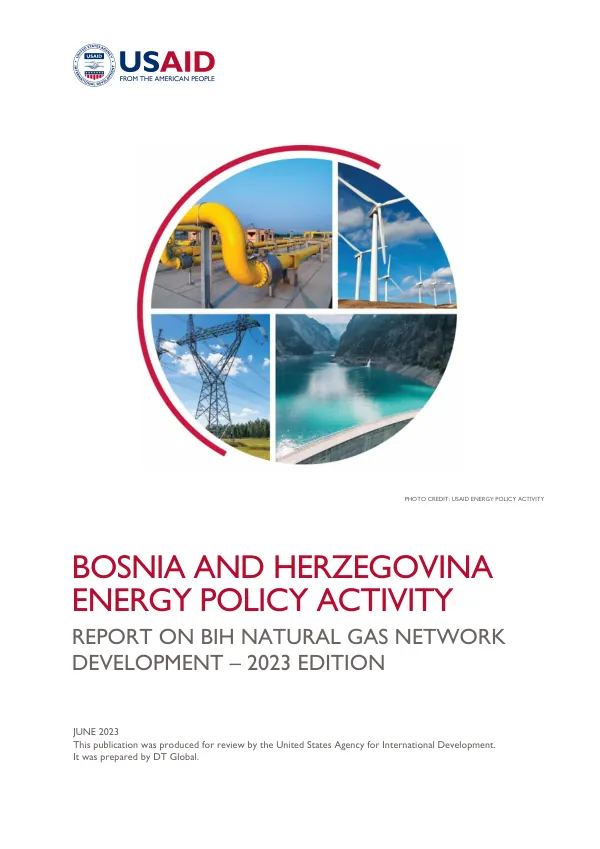
Report on Natural Gas Network Development in BiH - 2023 Edition
Bosnia and Herzegovina's (BiH) natural gas consumption is low due to limited resource access, under-developed transmission and distribution networks, low industrial usage, and higher prices compared to traditional heating fuels.
2023 · 22 pages
Sign in to readA free account is required to download.
Abstract
The per capita natural gas consumption rate in BiH is approximately 60 cubic meters per year, while in Serbia it is around 300 cubic meters per year, in Croatia 600 cubic meters per year, and within the European Union 28 Member Countries the average is over 900 cubic meters per year. BiH does not have its own natural gas production and is entirely dependent on gas imports. For over 41 years, from 1979 to April 1, 2021, the only source of natural gas for BiH was from Russia, transported from Russia through Ukraine, Hungary, and Serbia. However, in November 2018, the Russian company Gazprom completed the construction of the Turkish Stream pipeline, which runs directly from Russia to Turkey under the Black Sea. The TurkStream project consists of two pipelines with a capacity of 15.75 billion cubic meters per year each, with one pipeline intended for the Turkish market and the other for the European market. The European branch of the TurkStream runs from Turkey to Hungary across Bulgaria and Serbia. The supply of natural gas from Turkey and Bulgaria via TurkStream commenced in January 2020. Since January 1, 2021, Serbia has been receiving all its natural gas via the TurkStream, and since April 1, 2021, so has BiH. Russia remains the only source of natural gas for BiH, with the supply route having changed. The current gas transmission network in BiH is shown in Figure 1. The gas pipeline crosses the Serbia/BiH border at Sepak and continues to Zvornik, Kladanj, Sarajevo, Zenica, and up to Travnik. BiH started using natural gas in 1979 in Zvornik and Sarajevo, with the construction of the Zvornik – Sarajevo gas pipeline (112 km). The main reason for the construction of the natural gas pipeline was to reduce air pollution in Sarajevo by replacing solid fuels with gas, and to supply the Alumina Plant in Zvornik with natural gas. The transmission gas pipeline from Zenica to Travnik (40 km) was added in 2014, and the transmission gas pipeline Šepak - Bijeljina (22 km) has been constructed. Its connection to the main natural gas pipeline is expected soon. The transmission gas pipeline from Zenica to Travnik is currently not being used as there are no consumers in Travnik. The Sepak – Zvornik – Sarajevo – Zenica – Travnik pipeline diameter is 16 inches, with hand-over contracted pressure at Zvornik being 30 bar. The maximum technical capacity of the gas pipeline at the entry point to BiH is 708.1 million cubic meters per year or 1.940 million cubic meters per day. The first section of the gas pipeline from the Serbia/BiH border at Sepak to Zvornik (22 km) is operated by the transmission company Gas Promet a.d. Pale. The second section of the gas pipeline from Zvornik to Kladanj (40 km) is operated by the transmission company Sarajevo-gas a.d. Istocno Sarajevo. The third and longest section of the gas pipeline of 184 km (Kladanj – Sarajevo – Zenica – Travnik) is operated by the transmission company Sarajevo-gas a.d. Istocno Sarajevo. The BiH current gas transmission network is shown in Figure 2. The gas pipeline crosses the Serbia/BiH border at Sepak and continues to Zvornik, Kladanj, Sarajevo, Zenica, and up to Travnik. The transmission gas pipeline from Zenica to Travnik (40 km) was added in 2014, and the transmission gas pipeline Šepak - Bijeljina (22 km) has been constructed. Its connection to the main natural gas pipeline is expected soon. The existing natural gas infrastructure in BiH is limited, with the country relying heavily on imports from Russia. The TurkStream pipeline has provided a new route for natural gas imports, with the supply of natural gas from Turkey and Bulgaria via TurkStream commencing in January 2020. The current gas transmission network in BiH is shown in Figure 2, with the gas pipeline crossing the Serbia/BiH border at Sepak and continuing to Zvornik, Kladanj, Sarajevo, Zenica, and up to Travnik. The planned natural gas infrastructure projects in BiH are identified in the Framework Energy Strategy of BiH 2035, which was adopted in 2017. The strategy outlines the development of natural gas infrastructure in BiH, including the construction of new pipelines and the expansion of existing ones.
Related documents