USAID. BUR. FOR AFRICA. OFC. OF EASTERN AFRICA AFFAIRS
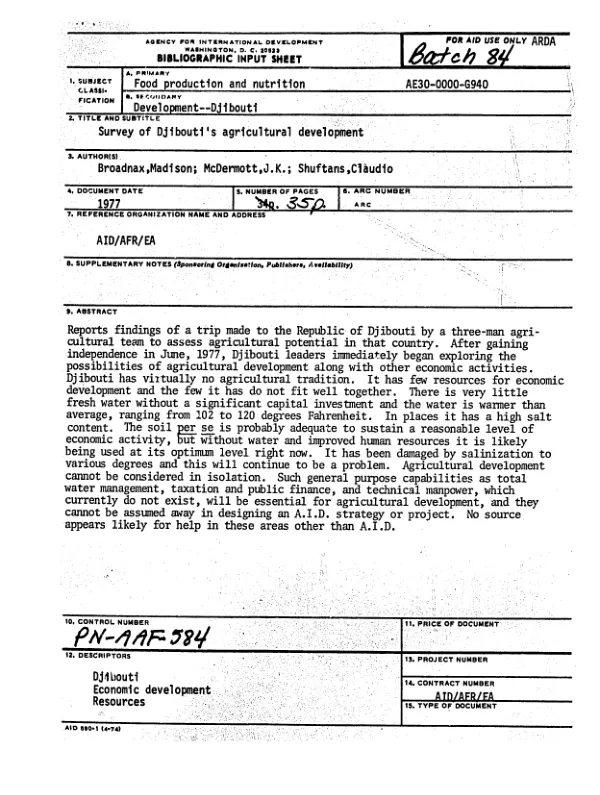
Report on survey of Djibouti"s agricultural development
Reports the findings of a trip made to the Republic of Djibouti by a three-person agricultural team to assess agricultural potential in that country.
Broadnax, Madison; McDermott, James K. +1 more · 1970
Sign in to readA free account is required to download.
Abstract
After gaining independence in June, l977, Djibouti leaders immediately began exploring the possibilities of agricultural development along with other economic activities. Djibouti has virtually no agricultural tradition. It has few resources for economic development, and the few it has do not fit well together. There is very little fresh water without a significant capital investment and the water is warmer than average, ranging from l02 to l20 degrees Fahrenheit. In places it has a high salt content. The soil is probably adequate to sustain a reasonable level of economic activity, but it is being used at its optimum level right now. It has been damaged by salinization to various degrees, and this will continue to be a problem. Agricultural development cannot be considered in isolation. Such general purpose capabilities as total water management, taxation and public finance, and technical manpower, which currently do not exist, will be essential for agricultural development, and they should be taken into account in designing an A.I.D. strategy or project. No source appears likely for help in these areas other than A.I.D.
Connected topics
Related documents