USAID. BUR. FOR LATIN AMERICA AND THE CARIBBEAN
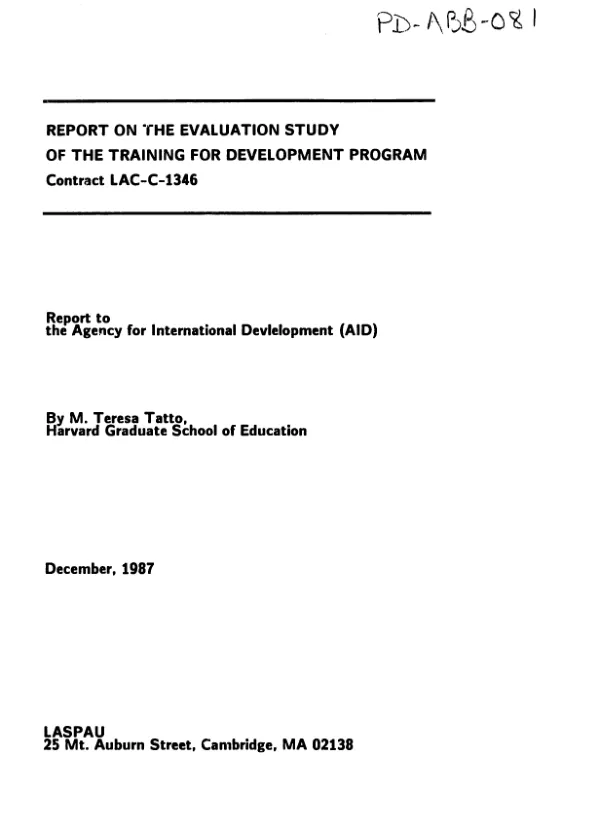
Report on the evaluation study of the training for development program
Evaluates a project (1978-86) to provide U.S.
Tatto, Maria Teresa · 1987
Sign in to readA free account is required to download.
Abstract
Master's Degrees to faculty of Latin American universities. Evaluation is based on interviews with alumni/ae, their supervisors, and their colleagues. The program selected 164 faculty members (teachers, administrators, and researchers) from 23 post-secondary institutions in 12 countries: Belize, Bolivia, the Dominican Republic, Ecuador, El Salvador, Guatemala, Haiti, Honduras, Jamaica, Nicaragua, Panama, and Peru. Participants' studies were in the areas of agriculture, engineering, education, and less frequently, health and the social sciences. The population served by the project was "high-risk" in that most came from provincial universities, were not members of an academic elite, and had no command of English before coming to the United States. Nonetheless, most (90%) performed well. On the other hand, only 50% felt that their U.S. experiences were wholly appropriate to their home institutions. The project had a significant impact on returned participants' regional outreach activities, and on their positive self-image and the level of innovations they initiated within their departments. Participants learned to act on their own to bring about change and utilize regional resources. After returning from the United States, their involvement in research and administration increased, while their teaching decreased. The overall impact of U.S training was greater at institutions that lacked other sources of graduate training opportunities abroad, institutions where a "critical mass" of professors had been trained, those with a positive disposition toward change, and where supplemental financial resources were available from international or national agencies. Other findings are as follows. (1) Training of faculty from rural universities is probably more costly, but the pay back may be greater. (2) Candidates should have clear plans and goals for their U.S. academic work, but the project is responsible for providing them with realistic expectations. (3) Placement of participants was most successful at those U.S. schools with genuine interest in Latin American studies. (4) A TOEFL score of 520-550 at time of admission is generally adequate. Good English language training programs are usually available in participants' home countries, and their use reduces expenses and periods of family separation. (5) Allowances for books and materials should be increased. (6) Funds for family maintenance were not available, and some participants withdrew early rather than remain apart from their spouses and children. (7) More follow-up activities, and networking activities of all sorts are recommended.