EGYPT. MINISTRY OF HEALTH
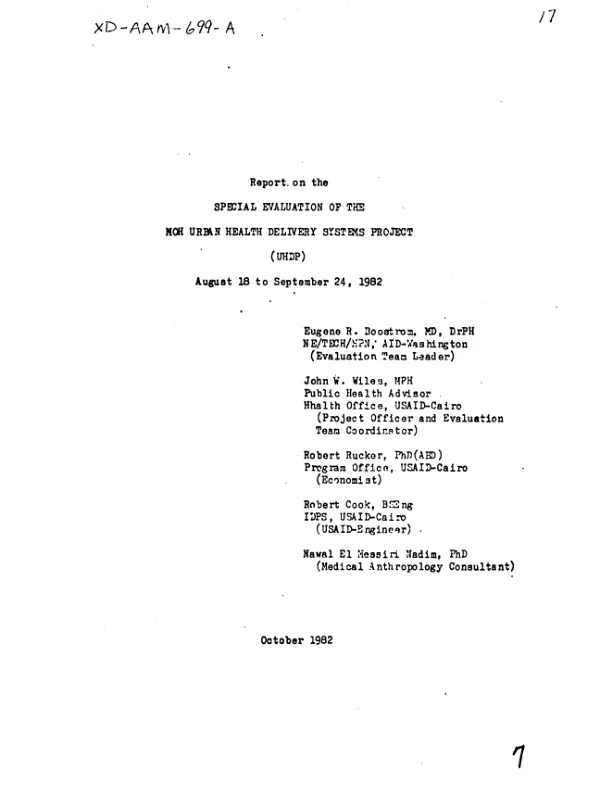
Report on the special evaluation of the Moh Urban Health Delivery Systems Project
Evaluates pilot project to upgrade the Egyptian Ministry of Health's (MOH) urban health delivery system.
Boostrom, Eugene R.|Wiles, John W. · 1982
Sign in to readA free account is required to download.
Abstract
Special evaluation covers the period 11/78-8/82 and is based on document review, interviews with project officials and beneficiaries, and inspection of project construction. Designed to improve health service delivery, the project has focused on constructing, renovating, and equipping facilities, these activities consuming 70% of project expenditures to date. Despite this emphasis, construction/renovation activities are behind schedule and the project's overall disbursement rate is low. If recommendations made in the evaluation are implemented, however, all planned construction should be completed by the project's end. Service-oriented aspects of the project have lagged, making it unlikely that the project will substantially improve the population's health status or MOH health service delivery. Achievements have included the training of 2,000 MOH and other project personnel in-country and the training of one long- and 65 short-term participants out-of-country. However, the training itself has not been skills focused and of 356 MOH staff interviewed by Egypt's Experimental Center for Training on Evaluation of Social Programs (ECTOR) during its urban health sector assessment only 46 claimed to have received formal training in the last 5 years (a discrepancy possibly due to the large staff turnover at maternal/child health facilities). Further, there is no sign that the MOH has institutionalized the methodology developed by ECTOR for the critically necessary data gathering and planning activities. Problems have been largely due to a too complicated, overly ambitious, unrealistic, and inappropriate project design and a project management that is highly centralized, does not provide incentives, and lacks basic management tools. Despite problems, A.I.D. assistance to the project should continue; there is still some chance the project might improve health services. Specific recommendations are to reorganize the project as several independent subprojects and to reorganize the project's central office; reemphasize service-oriented components; and develop innovative ways to overcome insufficient operating budgets.
Related documents
Documents in this collection
 1984
1984USAID DEC
Urban health delivery system project -- USAID project no. 263-0065 : project internal evaluation
Open record 1984
1984USAID DEC