USAID DEC
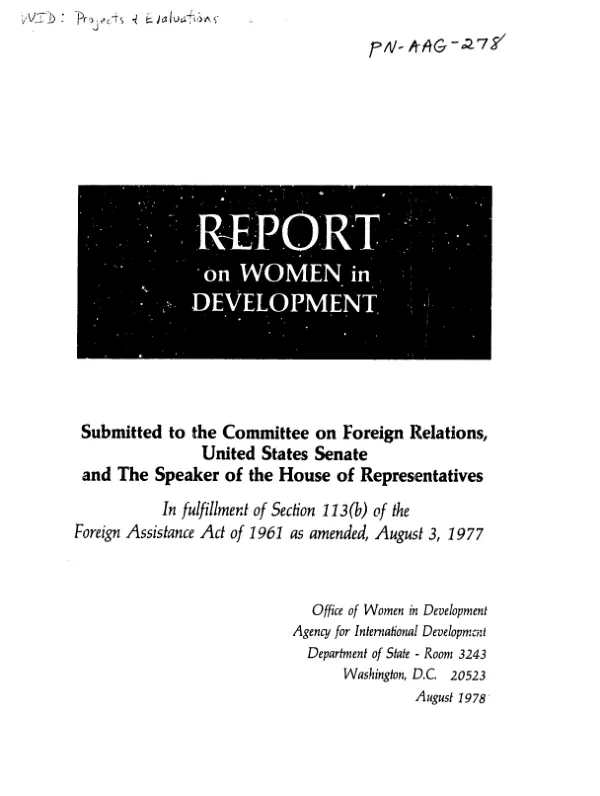
REPORT ON WOMEN IN DEVELOPMENT; SUBMITTED TO THE COMMITTEE ON FOREIGN RELATIONS, UNITED STATES SENATE AND THE SPEAKER OF THE HOUSE OF REPRESENTATIVES
Sign inUSAID. OFC. OF WOMEN IN DEVELOPMENT
REPORT ON WOMEN IN DEVELOPMENT; SUBMITTED TO THE COMMITTEE ON FOREIGN RELATIONS, UNITED STATES SENATE AND THE SPEAKER OF THE HOUSE OF REPRESENTATIVES
Describes the assumptions, programs, impacts, problems and needs for women in development since the Women in Development Office (WDO) was established in 1974.
1970
Sign in to readA free account is required to download.
Abstract
Distinctions among project activities as to what constitutes a women in development project include projects with womens" components integral to the project and women-specific projects which help them to "catch-up" to men in areas where women have been neglected. Projects which merely contained impact statements on women but which lacked deliberate effort to involve women were excluded from the report. Funding totals are provided only for women-specific projects. The report"s activities section explains why small-scale activities that interest and train people in the women in development concept must precede project design. These activities will promote awareness of women as wives and mothers and also as individuals who can and do contribute to development. Such activities would help bridge the gap between these roles, especially in health, nutrition, population and education projects. Considerations that could facilitate more effective integration of women"s components into future AID projects include education for young women, priority given to rural women, participatory roles for women and linkages between women"s organizations. The report"s data base section discusses general problems in collection and use of data for women in development and the pros and cons of the AID data base. National statistics on women in LDC"s have been gathered by the World Fertiltiy Survey and AID regional bureau Profiles on Women for the purpose of designing and evaluating AID projects. There has been, however, little or no systematic effort to supply AID/Washington with information about effective projects and general progress on integrating women into development. Other international development organizations as well as AID have developed data collection and monitoring systems to evaluate economic performance, but sources of data that could clarify social and personal economic progress are frequently aggregrated to relate only to the economic system and not the individual components. The authors of this report state that if women are to be finally integrated into mainstream AID projects, data on women must be fully integrated into the AID data system.
Related documents