ABT ASSOCIATES, INC.
Republic of Guinea : agricultural sector assessment
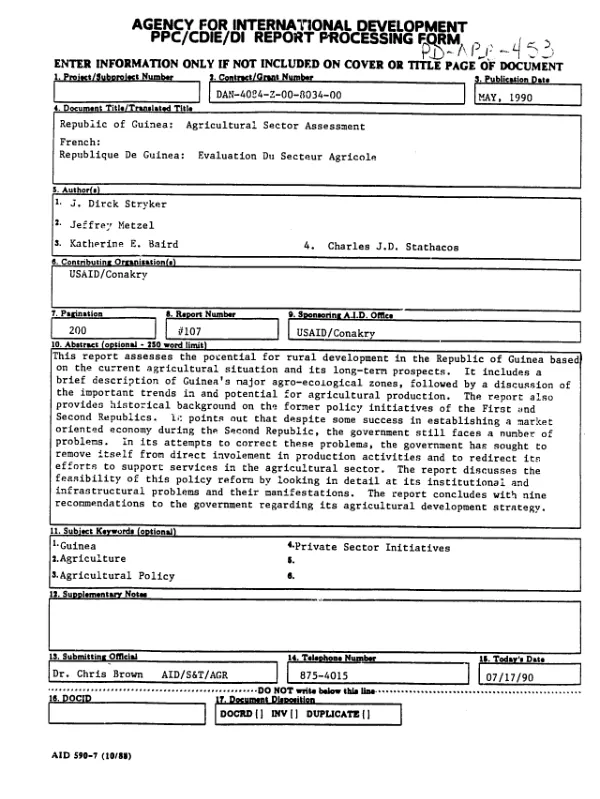
This report assesses the current agricultural situation and long-term prospects for rural development in Guinea, and recommends nine specific areas for A.I.D.
Stryker, J. Dirck; Metzel, Jeffrey · 1990
Sign in to readA free account is required to download.
Abstract
action to promote this development. Topics include a brief description of Guinea"s major agro-ecological zones; a discussion of the most important trends in and potential for agricultural production; and a summary of the important distortional policies pursued under the First Republic, the first reforms initiated during the early 1980"s, and the major policy changes that took place after the Second Republic was established in 1984. Despite the Second Republic"s success in establishing a market-oriented economy, a number of problems still face the government. These include: (l) an overvalued exchange rate, (2) lack of credit in rural areas, (3) administrative and other obstacles to trade, (4) legal and institutional impediments to private sector saving and investment, (5) an uncompleted process of government reform, (6) weak capacity to manage public investments, and (7) low levels of income and market demand in rural areas. The current government has sought to remove itself from direct involvement in productive activities while increasing its support services to the agricultural sector. However, its efforts are constrained by an austere budget, a strongly centralized bureaucracy, an incompletely defined organizational structure, insufficient technical expertise, inadequate control (with respect to specific departments) and monitoring mechanisms, and a deteriorating physical infrastructure. The report discusses these problems and their manifestations in detail. A separate section assesses private sector marketing and trade in Guinea, and the public"s role in facilitating and hindering these activities. The government, in conjunction with donor agencies, is in the process of creating an agricultural development strategy. The issues to be resolved in this process include (l) comparative advantage versus food security, (2) domestic prices stabilization, (3) low usage of intermediate inputs, (4) the appropriate form of agricultural extension services, (5) the promotion of unsubsidized rural credit, (6) the viability and sustainability of public investments, (7) the streamlining of external trade channels, (8) the removal of marketing and trade barriers, (9) improved investment incentives, and (10) enhanced management of Guinea"s natural resources. The recommended areas for A.I.D. action presented in this report are, in order of priority: (l) rural infrastructure, (2) agricultural development strategy, (3) agricultural export promotion, (4) reinforcement of the Ministry of Agriculture and Animal Resources, (5) rural enterprise development, (6) natural resource management, (7) livestock vaccine testing, (8) agricultural research, and (9) agricultural input distribution by the private sector. (Author abstract)
Related documents
![Agriculture sector strategy report [for USAID/Honduras]](https://covers.devme.ai/gen/32877.webp)