RTI INTERNATIONAL
Republic of Serbia Net-Metering Study: First Report
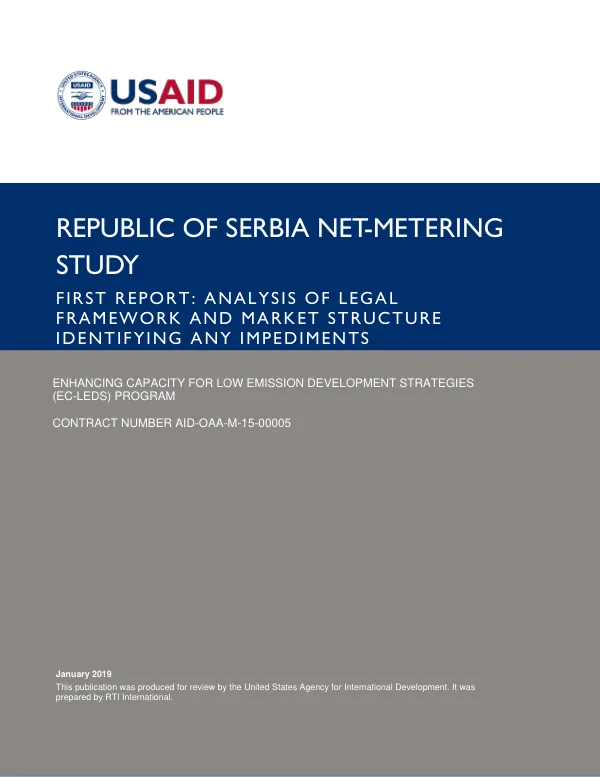
The Republic of Serbia's net-metering study, conducted under the Enhancing Capacity for Low Emission Development Strategies (EC-LEDS) Program, aims to assist Serbia in defining and introducing a successful approach to net-metering.
2019 · 51 pages
Sign in to readA free account is required to download.
Abstract
The study comprises three reports, with the first report analyzing the present market structure and legal and regulatory framework with special emphasis on impediments or issues preventing the introduction of net-metering in Serbia. The study examines the key elements of net-metering and their present status under Serbian law, including electricity pricing, energy activities and classification of prosumers, construction and environmental permitting of electricity facilities by SMEs/domestic consumers, metering, connection to the distribution network, and taxation overview as it applies to small producers. The analysis reveals that the current legal and regulatory framework in Serbia presents several impediments to the introduction of net-metering, including electricity pricing and incentives for potential small-scale investors in renewable energy. The study identifies the institutions and companies whose roles in the energy sector are important in terms of any introduction of a net-metering scheme, including the Ministry of Mining and Energy, Energy Agency of the Republic of Serbia, JP Elektroprivreda Srbije, EPS Distribucija d.o.o. Beograd, and others. The analysis also examines the potential for renewable energy investment in Serbia and the incentives for investment in renewable energy that presently exist. The study highlights the potential of renewable energy sources in Serbia, including solar PV, small hydro, and wind power. However, it also notes that the current incentives for generation of electricity using renewable energy sources are limited. The study identifies other potential issues or impediments to the introduction of net-metering in Serbia, including the need for legal amendments and changes to the existing regulatory framework. The study recommends possible legal amendments and changes to the existing regulatory framework, including amendments to the Energy Law and other relevant legislation. The analysis suggests that a more detailed description of the recommended amendments will be contained in the third report. The study concludes that the introduction of net-metering in Serbia requires a comprehensive approach that addresses the existing impediments and creates a favorable regulatory environment for small-scale renewable energy investors. The study's findings and recommendations are intended to assist the Government of Serbia in defining and introducing a successful approach to net-metering, which can contribute to the country's low emission development strategies and promote the use of renewable energy sources. The study's analysis and recommendations provide a valuable insight into the current state of the energy sector in Serbia and highlight the need for policy and regulatory reforms to support the development of small-scale renewable energy projects.