USAID DEC
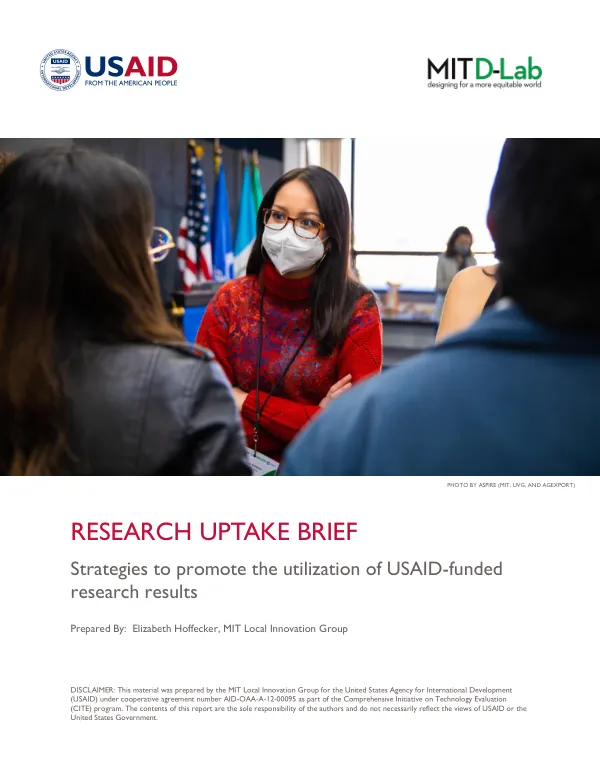
Research Uptake Brief: Strategies to Promote the Utilization of USAID-Funded Research Results
Sign inUSAID
Research Uptake Brief: Strategies to Promote the Utilization of USAID-Funded Research Results
The Comprehensive Initiative on Technology Evaluation (CITE) program, a USAID-funded project, aims to develop and disseminate rigorous evaluation methodologies for global development challenges.
2022 · 11 pages
Sign in to readA free account is required to download.
Abstract
The program is operated by the MIT Local Innovation Group, which conducts interdisciplinary social science research on local innovation and systems change in communities facing development challenges. To promote the utilization of USAID-funded research results, the MIT Local Innovation Group has developed a research uptake brief that offers strategies for promoting research uptake. The brief focuses on strategies for influencing key stakeholders within and external to USAID, with the goal of achieving policy, program, or other influence objectives. Research uptake is distinct from research communication and dissemination, as it focuses on encouraging the active use of research findings by specific audiences. To achieve research uptake, teams should implement uptake-focused strategies throughout the different phases of the research cycle, starting from the proposal development phase or at the earliest time feasible following receipt of funding. The first step in designing a research uptake strategy is to identify the project's influence goals. This involves asking questions such as: What or who are we hoping to influence through our research work and results? What do we hope will change or be done differently because of our work? Influence goals might focus on changing the structure of other projects or activities, influencing future calls for funding, changing norms or standard ways of doing things, influencing policy, a combination of these, or other goals. Once influence goals are defined, teams can identify how their work needs to be used for the desired influence to occur, which is known as research uptake objectives. This involves asking and answering questions such as: Who needs to understand and take action on our research results to achieve our influence goals? What do we hope those research users will do with our results? How will they use the results to achieve our desired policy, program, or other change? What is likely to motivate these individuals to take the desired actions? How can we contribute toward building their motivation to engage with and use our work? During the research design and planning phase, research teams can create a research uptake strategy that includes strategies such as identifying key audiences and stakeholders, becoming the go-to resource on the topic, identifying the most effective formats for results, and creating a research uptake timeline and budget. These strategies are intended to provide teams with a starting point for creating more tailored research uptake plans. In the research implementation phase, teams can make connections to current research, engage key resource people within USAID, and use accessible language in all written outputs. In the research dissemination phase, teams can disseminate findings in a variety of accessible places, focus pre-launch dissemination on in-person meetings and presentations, and focus post-launch dissemination on webinars, workshops, and presentations. By implementing these strategies throughout the research cycle, research teams can increase the likelihood of achieving their desired policy, program, or other influence objectives and promoting the utilization of USAID-funded research results.
Related documents