USAID
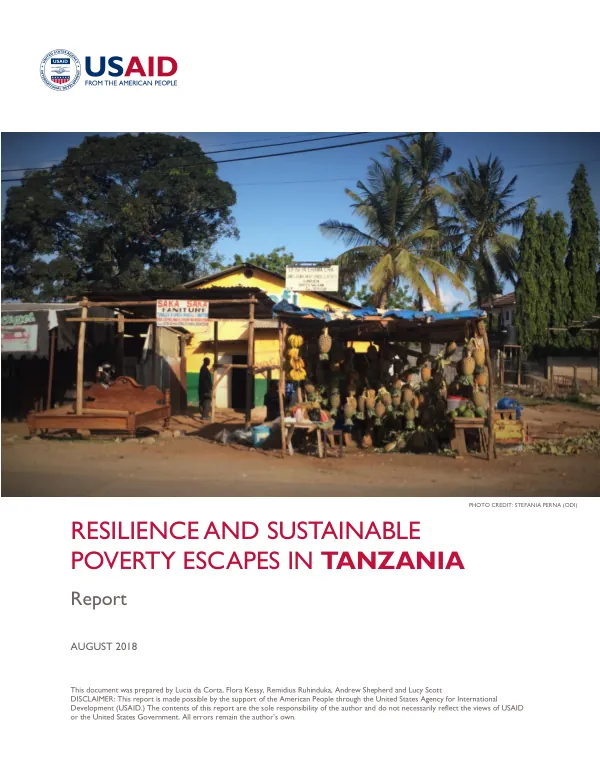
Resilience and Sustainable Poverty Escapes in Tanzania - Report
The focus of this report is on household poverty escapes and what explains why some households escape poverty and remain out of poverty (sustainable poverty escape, or resilience), while other households escape poverty only to fall back into poverty (transitory poverty escape) or descend into poverty for the first time (impoverishment).
2018 · 36 pages
Sign in to readA free account is required to download.
Abstract
Analysis of three rounds of the National Panel Survey (NPS) over 2008-2012 for this case study reveals that many poverty escapes in Tanzania are not sustained over time. Initial household resource base plays a significant role in determining the likelihood of sustained poverty escapes. Asset accumulation significantly increases the likelihood that escapes from poverty will be sustained, as according to the regression results. Qualitative fieldwork reveals how sustained escapers increased investments across the board, including in farming, off-farm businesses, housing and transport vehicles for rent, and had high levels of savings. Owning more livestock, however, significantly increases the likelihood of a transitory, rather than a sustained poverty escape, potentially due to the fragility of investing solely in livestock. Household characteristics also matter for the likelihood of sustained poverty escapes. Household size and dependency ratios are significant factors, with the fieldwork revealing a clear distinction between sustained escapers and the chronically poor, who have more children and a higher number of dependents. Education has been a key factor in sustaining poverty escapes for the current generation of household heads, with secondary education in particular playing an important role in ensuring a household's ability to escape poverty sustainably. Household activities also play a crucial role in determining the likelihood of sustained poverty escapes. Agriculture figures prominently in most life histories, with households often diversifying within the agriculture portfolio by expanding agricultural activities over time and/or making investments in technologies and new crop varieties to add value to farming. Sustained escapers made investments to diversify into a variety of non-farm businesses, contrasting with the non-farm activities with low start-up costs of the chronically poor, such as engagement in petty trade. Accessing loans from good finance institutions and then moving up the finance chain to Savings and Credit Cooperative Society (SACCOs) and bank savings and loans was a key aspect of building the diversified livelihoods required to achieve a sustained escape from poverty. Household shocks and stressors also impact the likelihood of sustained poverty escapes. Sustained escapers in the life history interviews remained resilient in the face of economic instabilities, with a key reason being their high level of livelihood diversification across agricultural and non-farm activities and their ability to maneuver into new activities and out of unproductive ones. For transitory escapers and the chronically poor, life histories reveal how the death of a breadwinner, poor health, illness, and associated financial shocks all had a downward push in wellbeing. The report highlights the importance of diversification in livelihoods activities and assets across and within sectors as the bedrock for poverty escapes. Sustained escapers concurrently invest in expansion or value addition to both agriculture and non-farm activities, and maneuver into new economic activities as prospects rise. Investments are supported by beneficial financial inclusion, with the pace of borrowing and investing increasing enormously as households move up well-being levels.