UNIVERSITY OF CALIFORNIA AT DAVIS
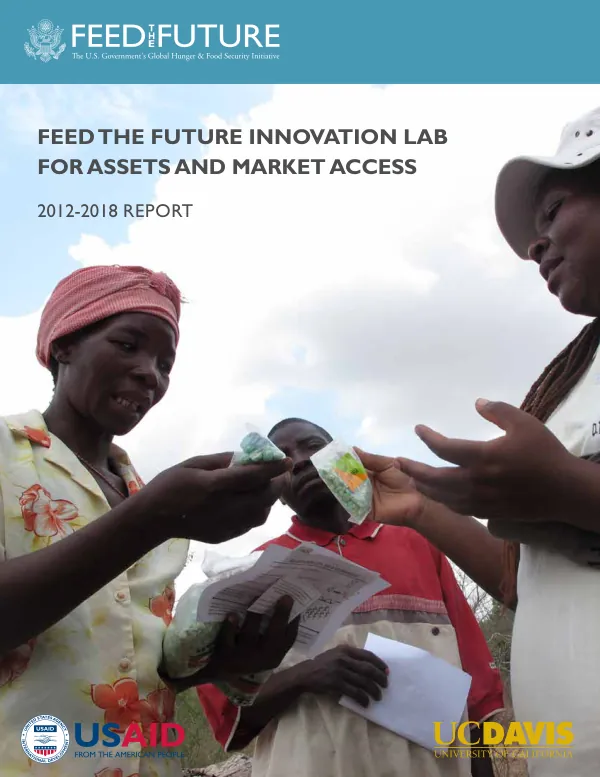
Feed the Future Innovation Lab For Assets and Market Access 2012-2018 Report
The Feed the Future Innovation Lab For Assets and Market Access was established in 2012 by the USAID Bureau for Food Security as a Collaborative Research Support Program (CRSP) at the University of California, Davis.
2019 · 68 pages
Sign in to readA free account is required to download.
Abstract
The lab's foundational theory, developed over a decade of research, posits that households' levels of assets are better predictors of chronic poverty than income. When assets fall below a minimum threshold, individuals become trapped in chronic poverty with no pathway to resilience. The lab's research has focused on three key areas: Inclusive Market Access, Risk Management and Resilience, and Rural and Agricultural Finance. Through 32 projects across 16 countries, the lab has conducted basic research, program evaluations, and low-cost pilots to test innovations. Principal Investigators from leading institutions worldwide have used established and cutting-edge research methods, including randomized controlled trials, digital innovations, satellite technology, advanced qualitative analysis, and machine learning. The lab's work has yielded valuable knowledge and innovations ready to be taken from the lab to the field. The research has established three fundamental and complementary pathways into and out of poverty: assets, capacities, and risk. The lab's field trials have contributed significantly to understanding these dynamics and provided the opportunity to design and evaluate programs intended to reduce poverty and promote resilience. The lab's research has also highlighted the importance of risk management in promoting resilience. Agricultural insurance is a key tool for promoting resilience as both a safety net in bad years and a way to promote investments for a higher income in the good. The lab has contributed to a growing base of evidence that high-quality index insurance acts as an effective safety net, keeping households from selling off assets or reducing consumption after a weather-related catastrophe. The lab has developed a Minimum Quality Standard for agricultural insurance to ensure that index insurance works as theorized and has high impacts. The standard emphasizes the importance of transparency, fairness, and affordability in index insurance contracts. The lab's research has also shown that low-quality contracts can leave households worse off than having no insurance at all. The lab's work has implications for promoting resilience and reducing poverty in small-scale agricultural households globally. The research has highlighted the importance of increasing assets and capacities while managing or transferring risks. Poverty graduation programs, which increase assets and capacities, provide a unique opportunity to test the dynamics of poverty and resilience when agricultural insurance is added. The lab's research has also emphasized the need for a contingent transfer, such as agricultural insurance, to keep vulnerable households from falling into poverty. This phenomenon, known as the "social protection paradox," presents a real opportunity for promoting resilience when scaled to national social protection budgets, particularly for countries in Sub-Saharan Africa and others that face a growing threat of weather-related shocks. The lab's work has contributed significantly to the understanding of poverty dynamics and the importance of risk management in promoting resilience. The research has provided valuable knowledge and innovations ready to be taken from the lab to the field, with implications for promoting resilience and reducing poverty in small-scale agricultural households globally.