CORNELL UNIVARSITY INTERNATIONAL
Resource-management technologies for sustainable agriculture
The TropSoils program is a global initiative aimed at developing and adapting improved soil-management technologies for developing countries in the tropics.
2015 · 2 pages
Sign in to readA free account is required to download.
Abstract
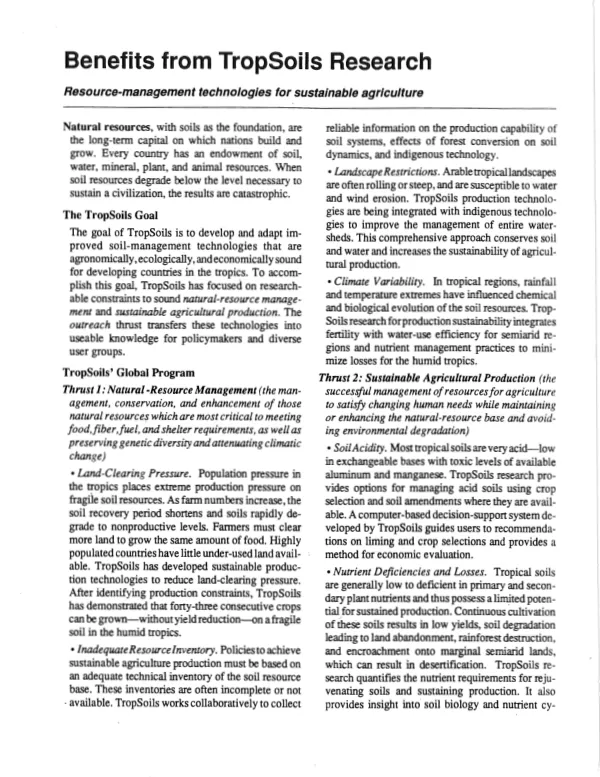
The program's primary goal is to enhance sustainable agricultural production while preserving natural resources and avoiding environmental degradation. To achieve this objective, TropSoils has focused on researchable constraints to sound natural-resource management and sustainable agricultural production. One of the key thrusts of the TropSoils program is natural-resource management, which encompasses the management, conservation, and enhancement of critical natural resources such as soil, water, and minerals. This thrust addresses several critical issues, including land-clearing pressure, inadequate resource inventory, landscape restrictions, and climate variability. For instance, TropSoils has developed sustainable production technologies to reduce land-clearing pressure, which has enabled farmers to grow 43 consecutive crops without yield reduction on fragile soils in the humid tropics. Another critical thrust of the TropSoils program is sustainable agricultural production, which focuses on the successful management of resources for agriculture to satisfy changing human needs while maintaining or enhancing the natural-resource base and avoiding environmental degradation. This thrust addresses several key issues, including soil acidity, nutrient deficiencies and losses, soil physical limitations, and topographic limitations. For example, TropSoils research has provided options for managing acid soils using crop selection and soil amendments, and has developed techniques for water harvesting and nutrient management to increase water-use efficiency. The TropSoils program also has a strong outreach component, which aims to transfer technologies into usable knowledge for policymakers and diverse user groups. This thrust addresses several critical issues, including the number and diversity of soils, lack of local expertise and information, information-knowledge gap, and lack of skills and research capabilities. For instance, TropSoils has provided opportunities for more than 100 soil scientists from developing countries to earn graduate degrees, and has developed decision-support systems and adapted geographic information systems to capture new technologies that can be integrated with indigenous knowledge to hasten technology transfer to individual farmers and diverse land-management units. The TropSoils program is a collaborative effort involving several universities and research institutions, including North Carolina State University, the University of Hawaii, Texas A&M University, and Cornell University. The program's research and education programs are coordinated by a team of experts in soil science, agronomy, and related fields, who work together to develop and adapt improved soil-management technologies for developing countries in the tropics.