INTERNATIONAL FOOD POLICY RESEARCH INSTITUTE (IFPRI)
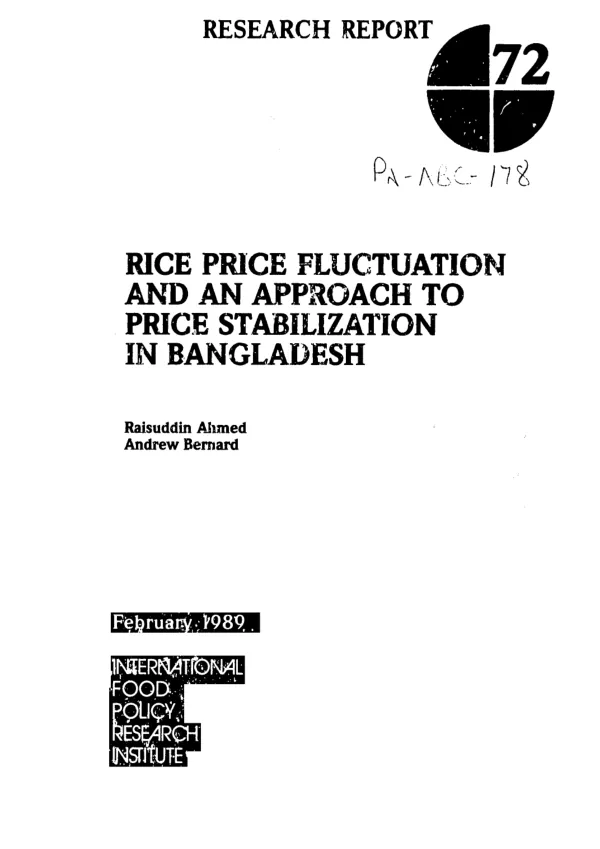
Rice price fluctuation and an approach to price stabilization in Bangladesh
Stabilization of prices, particularly of major food grains, is a serious concern of most developing countries.
Ahmed, Raisuddin; Bernard, Andrew · 1989
Sign in to readA free account is required to download.
Abstract
This report examines the increasing variability of rice prices in Bangladesh and provides a framework for limiting that variability in the future. This framework, which is considered by the authors as applicable to most developing countries, consists of four steps. First, nominal prices are decomposed into trend, seasonal, and irregular components. Second, causes of price movements are analyzed. Third, the degree of market integration is measured, and fourth, target annual average prices are predicted and the annual average is linked with the seasonal factors to arrive at seasonal target prices for stabilization. This framework implies a shift from a quantity-targeted to a price-targeted approach in managing the public food system. It specifies a price band in annual prices and links this band to seasonal prices, keeping in view both cost and price stability. Results indicate that a successful price stabilization program will substantially reduce pressure on the rationing system, and the process can be even more effective if pricing of rationed foodgrains, particularly of priority groups, is coordinated with market prices.
Connected topics