USAID. MISSION TO PERU
Rural development agribusiness fund
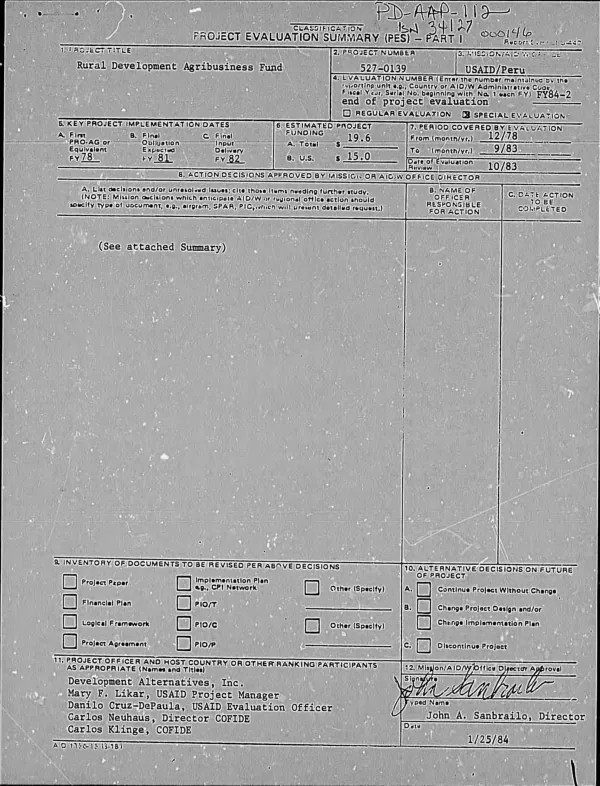
Evaluates project to establish a discount facility, the Rural Development Agribusiness Fund (FRAI), in the Central Bank of Peru to provide loans through intermediary credit institutions to rural poor agribusinesses.
Likar, Mary F.; Cruz-DePaula, Danilo · 1984
Sign in to readA free account is required to download.
Abstract
PES covers the period 12/78-9/83 and is based on a special evaluation. (XD-AAP-112-A) Lessons learned include: (1) targeting resources away from or to certain subprojects in industrial areas is often undertaken to maximize target group impact. However, restrictions on lending tend to put a static criterion on a dynamic economic environment, often subvert the purpose of economic analysis, and should be carefully analyzed. (2) Interest rate spreads are of critical importance in determining the success of intermediary credit institutions" mechanisms. Spreads that are too low will not encourage innovative change while spreads that are too high distort financial markets. (3) Determining the indirect impact of agroindustry projects on small farmers and A.I.D."s target group is a difficult process complicated further by the cyclical nature of the agroindustrial process. Evaluations aimed primarily at target group impact should be carried out several years after the "normalization" of agribusiness process has begun. (4) Policy environment plays a critical role in project success. (5) Negative interest rates to sub-borrowers distort investment decisions.
Connected topics
Related documents