USAID. MISSION TO PERU
Drug education and public awareness
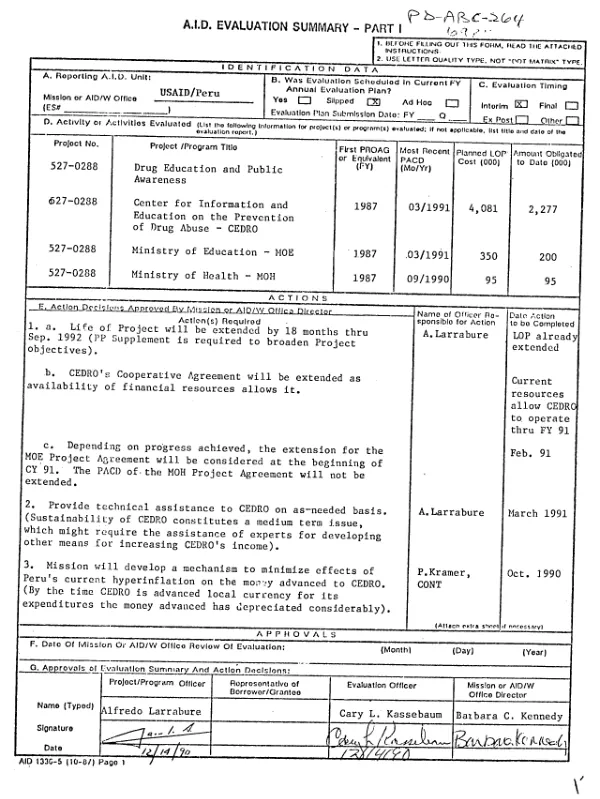
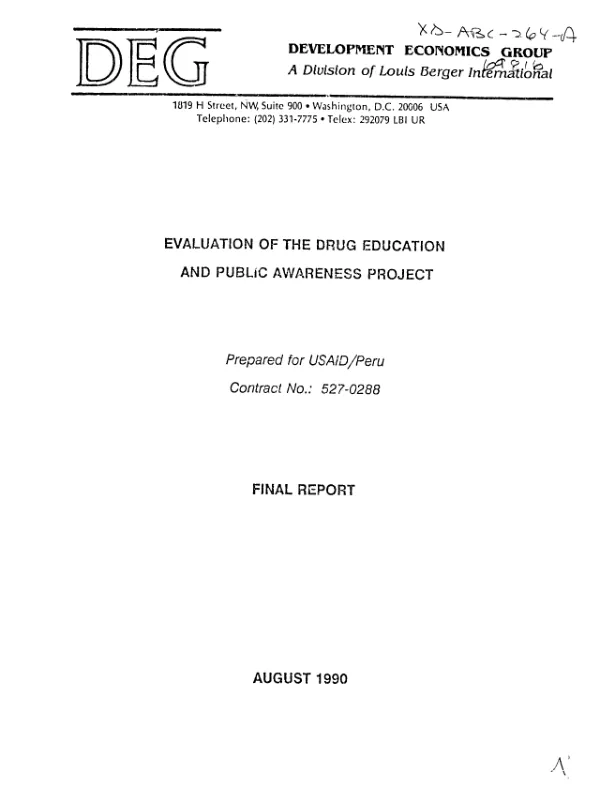
Summarizes interim evaluation (XD-ABC-264) of a project to increase public awareness of drug abuse, production, and trafficking in Peru.
1990
Sign in to readA free account is required to download.
Abstract
External evaluation covered the period FY87-8/90. All objectives have been met, and the project could serve as a model for replication in Latin America and worldwide. The Drug Education Center (CEDRO), the primary implementing agency, is a permanent, prestigious, and independent drug education and information center. While CEDRO is still not financially independent, non-A.I.D. donations to the center have doubled every year since 1987. These donations, however, have been primarily in-kind for such things as radio and television time. CEDRO"s major problem is related to Peru"s hyperinflation, which exceeds 40% per month. By the time the Mission advances local currency to CEDRO, the money has depreciated considerably. CEDRO"s public awareness efforts appear to have been effective, with 90% of Peruvians now perceiving drug production, trafficking, and abuse as problems which warrant government attention. This high level of concern is in sharp contrast to perceptions prior to project initiation. However, most Peruvian elites do not share the general public"s support for coca eradication. A recent CEDRO survey of 2,500 Peruvian leaders indicates widespread opposition to large-scale eradication programs. Instead, the leaders recommend that crop substitution programs be implemented before threatening peasants with crop eradication. Project activities implemented by the Ministry of Education and the Ministry of Health have also achieved their objectives, despite fiscal restraints caused by the economic crisis and widespread labor strife within government agencies. The success of the project can be attributed to the following: (1) a thorough pre-design study of the problem; (2) an outstanding TA provider (Development Associates); (3) a socially diverse CEDRO founders" group; (4) a limited project focus; (5) highly qualified and dedicated CEDRO staff; (6) a streamlined staff level; (7) modest funding levels; and (8) careful, but not intrusive, Mission monitoring. The major lesson learned is that drug education and public awareness projects are complicated, politically and emotionally sensitive, and difficult to implement. Progress is uneven and sporadic, and transition from awareness to eradication is a long- term process.
![USAID/Peru strategic objective closeout report : USAID/Peru special objective -- "reduce illicit coca production in target areas in Peru" [SpO] 527-005](https://covers.devme.ai/gen/44205.webp)