USAID. MISSION TO MALAWI
Rural enterprises and agribusiness development institutions (READI) project
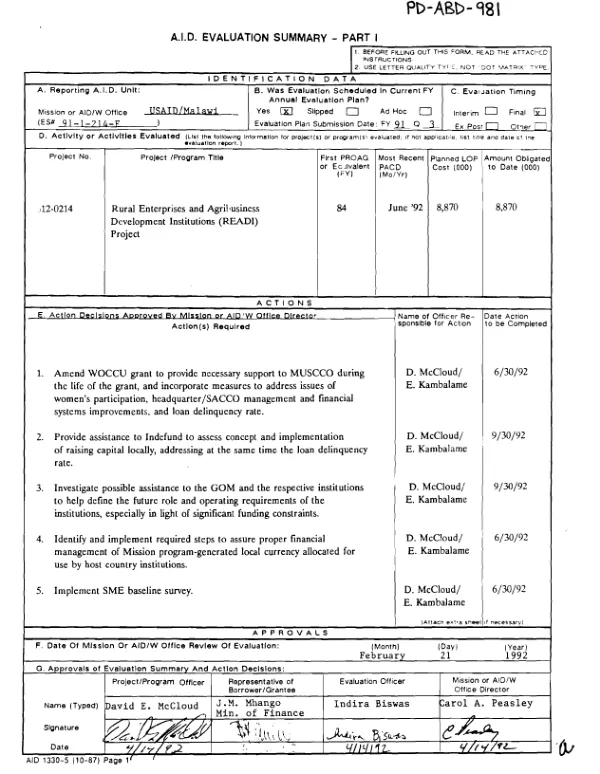
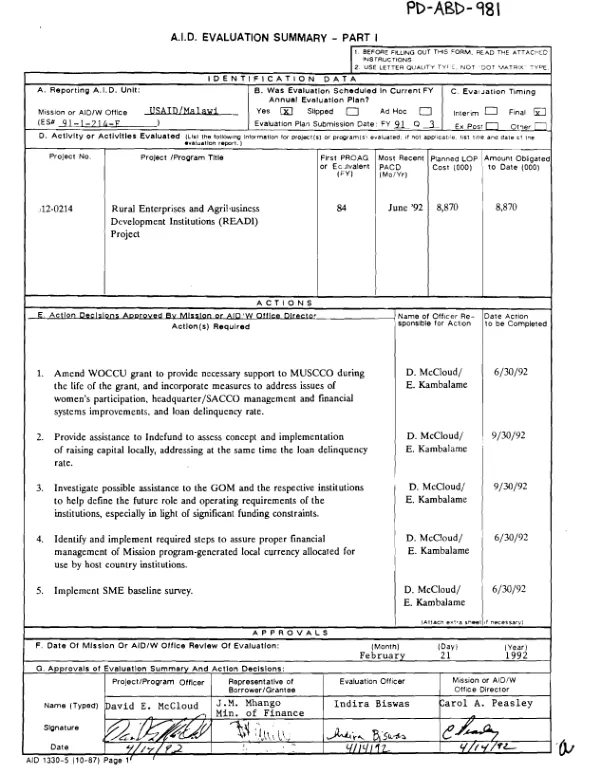
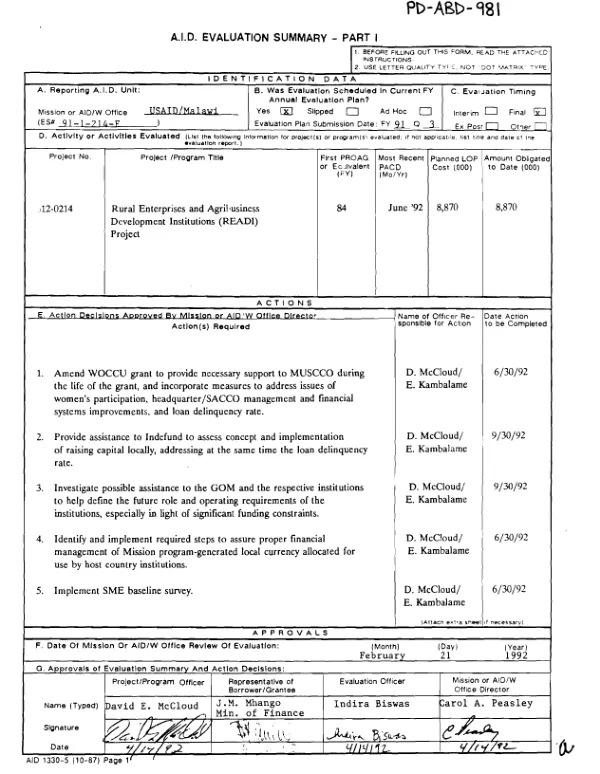
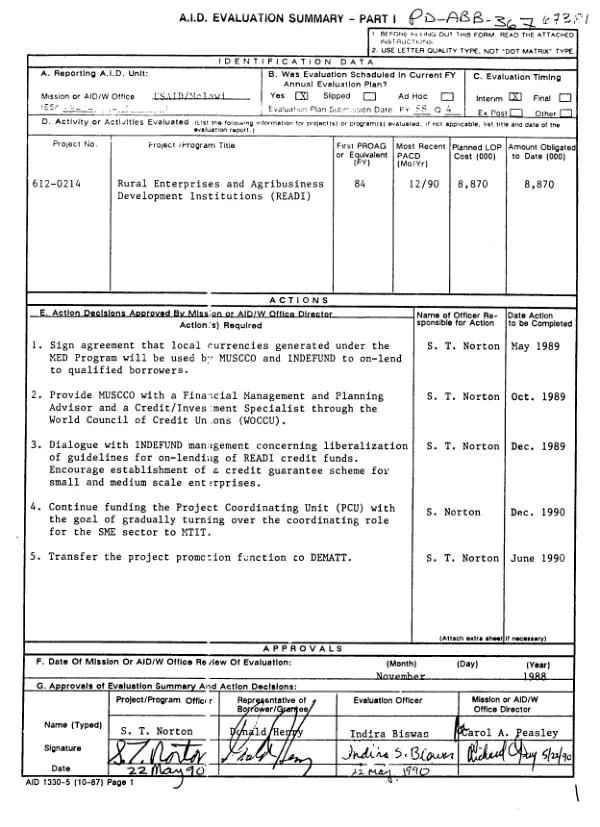
Summarizes final evaluation (XD-ABD-981-A) of a project to strengthen institutions that support small and medium enterprises (SME"s), especially those involved in agribusiness and rural development, in Malawi.
1992
Sign in to readA free account is required to download.
Abstract
The evaluation covered the period FY84-8/91. The project played a pivotal role in strengthening SME support institutions. MUSCCO is currently managing 123 savings and credit cooperatives, compared to fewer than 50 in 1985. INDEFUND has 163 loans outstanding, 54 of them financed with project resources. INDEFUND loans have directly created 2,927 jobs. DEMATT is promoting new business ideas, implementing new service delivery technologies, and developing entrepreneurs. The Project Officers and Entrepreneurs Training Program (POET) is still in its initial organizational phase, but appears to be providing valuable services to its clients. Considerable problems remain. INDEFUND"s delinquency rate indicates a weakness in appraisal and monitoring systems. DEMATT continues to have problems in its overall management and in recruiting and retaining qualified staff. MUSCCO"s overall operation and financial management have suffered from the rapid growth of savings and credit cooperatives. Local funding sources must be found for POET if it is to survive. In terms of financial sustainability, MUSCCO and INDEFUND have made progress, while DEMATT and POET are dependent on donor funds. The institutions are also too dependent on expatriate managers (a problem frequently encountered in Malawi). Moreover, in their efforts to achieve financial sustainability, the institutions have moved away from their development goals, for example by focusing services on urban area and more affluent clients and by excluding women from decisionmaking and beneficiary roles. One matter which is particularly bothersome concerns the transfer of project management functions to the Ministry of Trade and Industry and the various participating institutions. With the departure of the contract project manager, coordination apparently has ended and required actions by the various actors are not fully understood and therefore not accomplished. Four major lessons were learned. (1) Developing effective institutions in a society where literacy rates and incomes are exceedingly low and where government intervention is pervasive is a management-intensive and long-term exercise, and frequently frustrating. (2) Unless lending institutions are able to raise capital on the local markets or in some other way mobilize savings, their institutional and financial viability as independent entities is questionable. (3) Mixing the Mission"s project management functions with a contractor"s project implementation functions gives the Mission insufficient oversight and the contractor too much authority. (4) While a government may participate in an SME support institution"s development, it should not be involved with the management of the institution. Despite the recommendation of the evaluation report, the Mission decided not to design a full-fledged follow-on project. It will, however, remain active in the SME sector through its work with MUSCCO, the SME baseline survey, private enterprise-NGO development under the SHARED project, etc.
![Small and micro enterprise development project no. 262-0212 [i.e. 263-0212], Egypt : midterm evaluation](https://covers.devme.ai/gen/8461.webp)
![Small and micro enterprise development project no. 262-0212 [i.e. 263-0212], Egypt : midterm evaluation](https://covers.devme.ai/gen/106688.webp)