USAID. MISSION TO SENEGAL
Rural health/child survival
Summarizes final evaluation (PD-ABE-756) of a project to establish a rural health delivery network in Senegal"s Fatick and Kaolack regions.
1992
Sign in to readA free account is required to download.
Abstract
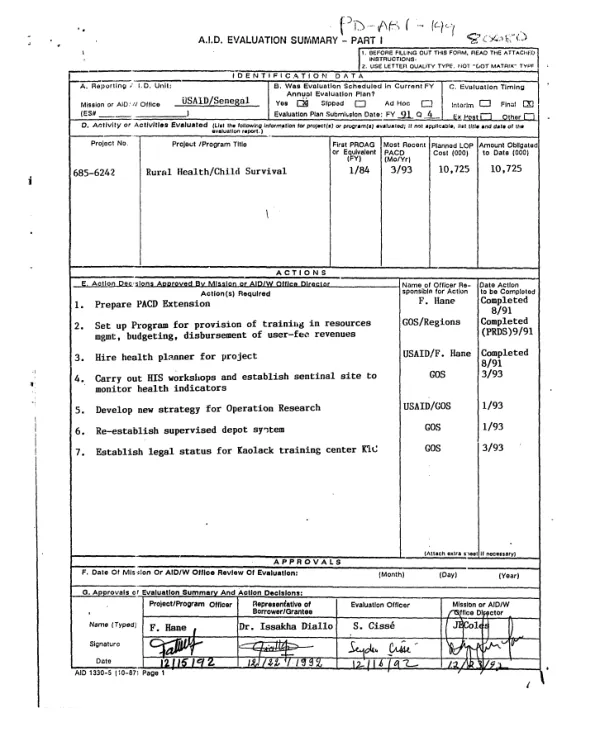
The evaluation covered the period 5/86-9/91. Subsequent to the evaluation, the PACD was extended to 3/93, with a decrease in LOP funding of $10.7 million. Achievement of the project"s purpose -- to increase agricultural productivity by reducing days lost due to illness -- proved impossible to measure accurately. However, it was the perception of all, actors and beneficiaries, that the purpose had been attained due to decreased family illness, reduced travel time and cost, and increased availability of lower-cost drugs at the village level. More health huts were functioning than health officials had thought. The health hut system is an appropriate strategy for providing basic preventive and curative health care in Senegal and should be expanded. Also, combining several interventions at the health post and hut levels has proved to be an effective way to deliver services to rural populations and a promising means toward financial sustainability. Despite inadequate numbers of trained public health cadres and difficulties in getting regional and district health plans written, the decentralization process has moved forward and planning capability has increased. Implementation of Phase II of the project -- to have begun in 1989 -- was seriously delayed due to a covenant requiring that regions prepare health planning and development documents before activities could begin. The project"s assumptions about the time and economic setting needed for achieving sustainability and transferring responsibility to the host country were flawed; institutionalization of a sustainable supervision system down to the village level has not yet been achieved. Much more work is required before the Health Information System can provide manageable, relevant, and accurate data, standardized reports, and analyses of epidemiological and management information. The Operations Research component never became fully operational nor responsive to project needs. The pharmaceutical supply system is hampered by a lack of supervision and resources to support transportation costs. Training of health staff was initially successful but slowed early in the project due to the departure of key trained personnel, budgetary constraints, and a void in regional leadership. Few short- or long-term trainees have returned to work in the project area for any significant length of time, though many have been assigned to headquarters or other areas with higher levels of responsibility. A national health training plan is still incomplete. In regard to project management, there have been serious problems in providing effective TA due to reticence on the part of the GOS to take on TA and lack of appreciation for the potential value of this resource. Also, there has not been effective planning and use of GOS counterpart funds. It was recommended that the PACD be extended to permit completion of health planning and development documents in the region, as well as other health system improvements. Lessons learned concern the evaluation process. (1) The requirements in the evaluation scope-of-work proved very difficult and burdensome. The Mission needs to be more realistic in its expectations about what evaluation teams can accomplish; moreover, efforts must be made to provide advance documents to team members so as to free up their often limited time in-country for field work. (2) Regarding project design, objectives must be realistic and measurable. If a baseline survey is done, a follow-up survey, employing a similar methodology, should be conducted to determine any changes in indicators. (3) Joint host country and USAID/contractor teams are desirable and superior; funding for translation needs to be added to accommodate dual teams. Overall, the Mission agreed with the findings and recommendations of the evaluation. It has taken steps to focus efforts on the inadequacies detailed above, and has prepared a PACD extension.