USAID. MISSION TO LIBERIA
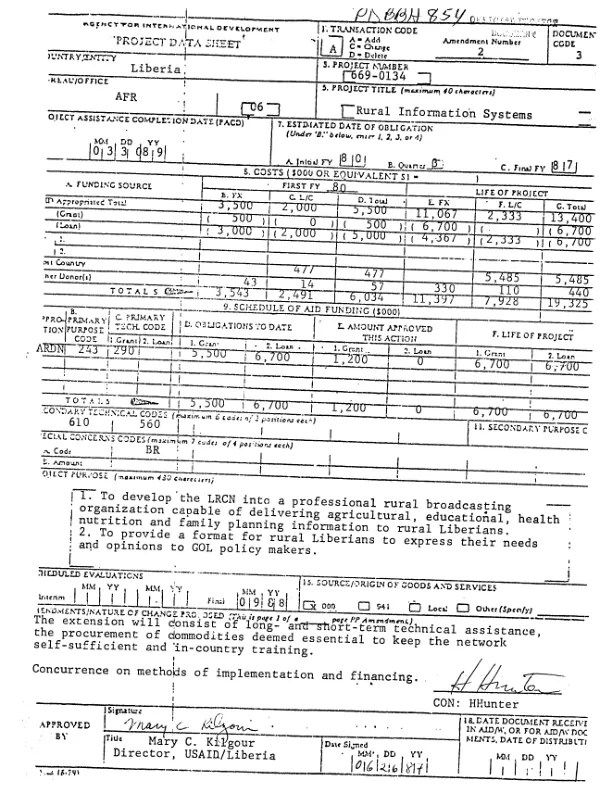
Rural information systems, 669-0134
Summarizes attached initial evaluation (XD-AUU-049-A) of a project to use radio to transfer information on Government of Liberia (GOL) development opportunities and services, especially in education, agriculture, and health, to rural populations.
Frymire, Larry; George, Peter Amos, Jr. · 1984
Sign in to readA free account is required to download.
Abstract
The evaluation covered the period 8/80-10/83 and was based on document review and interviews with Project Steering Committee members, the USAID/L Project Manager, staff of the Liberian Rural Communications Network (LRCN), and TA advisors. The project is behind schedule; to date, no programs have been produced in the vernacular, there has been no broadcasting, and delays in presenting final designs have delayed bidding on construction (which it is hoped will begin in 4/84). Further, due to low estimates on construction and equipment costs and a deteriorating economy which has made it impossible for the GOL to cover recurrent costs, the target of 7 regional radio stations has been reduced to 4 (including one renovation). GOL financial woes could also jeopardize the in-country training of a second group of technicians (the first group was trained on schedule). The project can still achieve its purpose if corrective measures are taken soon on its major problems. These have been: an ineffective project management structure; unskilled GOL managers; poor planning; inadequate progress in transferring technical skills due to communication problems between the TA team (which arrived 18 months late) and local project staff; and jurisdictional disputes between the Project Steering Committee, whose bylaws give it policy control over the project, and the Liberian Broadcasting System (LBS), which possesses legal control over LRCN and whose new Director does not accord the project a high priority. The key lesson learned is that projects as complex as this need adequate lead time for managers and others to obtain extensive practical academic training. In addition, hands-on internships in a similar operational environment should be provided, and initial recruitment and selection of potential managers and key operational staff must be exacting to ensure that persons with as many applicable skills as possible are employed. The success of such projects depends on early excellence in managing them.