USAID. MISSION TO NIGER
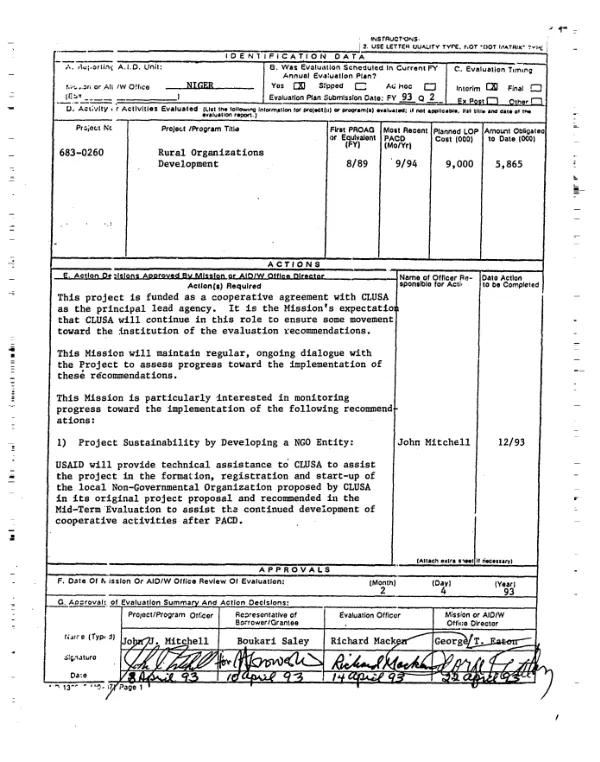
Rural organizations development
Summarizes mid-term evaluation (PD-ABF-570) of a project to strengthen cooperatives in rural Niger.
1993
Sign in to readA free account is required to download.
Abstract
Evaluation covers the period 8/89-2/93. The project attempts to change Nigerien farmers" perceptions of cooperatives, which are based on a history of excessive government control of and intervention in the cooperative movement. Principal project activities include increasing and diversifying economic activities of the rural population of Niger by developing cooperatives modeled after the Cooperative League of the USA (CLUSA); cooperative management training of rural inhabitants; loan servicing; and project sustainability through the evolution of an NGO. The mid-term evaluation was conducted by Chemonics International on the basis of a review of project documents, visits to 13 rural cooperatives, and interviews with project and Mission staff, project participants and beneficiaries, and other project collaborators. The purpose was to assess project effectiveness relating to its management, training activities, and use of its loan guarantee fund; its progress in sustaining project outputs; and its inclusion of women as participants and beneficiaries. Major findings and conclusions are as follows. (1) The existing national law has restricted flexibility in developing productive cooperatives. One example of this is the formation of cooperatives based on geographical proximity and the requirement that all male villagers within a designated area become members. This has resulted in co-ops that are much to large to engender the trust among members needed to assure repayment of loans. (2) Most cooperatives under the project"s umbrella are engaged in economic activities which have limited potential for growth, tend to compete with private businesses, and generate small profit margins. (3) Whereas the efficacy of training given to cooperative trainers and members could not be adequately assessed due to lack of a good monitoring system, it appears that training of project collaborators, such as the Association Francaise des Volontaires de Progres (the French counterpart of the Peace Corps), has been very successful. (4) The credit program is effectively permitting access to loans for co-op members through the use of a guarantee fund. The following are lessons learned. (1) Group Mutualistes, which are subdivisions of co-ops, and specialized groups, e.g., members of the same trade, appear to be appropriate size groups for the project to work with. (2) Co-ops which have local traders as active members appear to be operating more productively than those that do not. (3) The performance of both training and credit activities by the same persons limits the effectiveness of both activities. (4) Changes in farmers" perceptions of co-ops have evolved very slowly. (4) The cultural and societal constraints inhibiting women from participating in project activities were underestimated. The project"s strategy for integrating Nigerien women into existing cooperatives has proven to be invalid. (Author abstract, modified)