USAID. MISSION TO HONDURAS
Rural technologies project
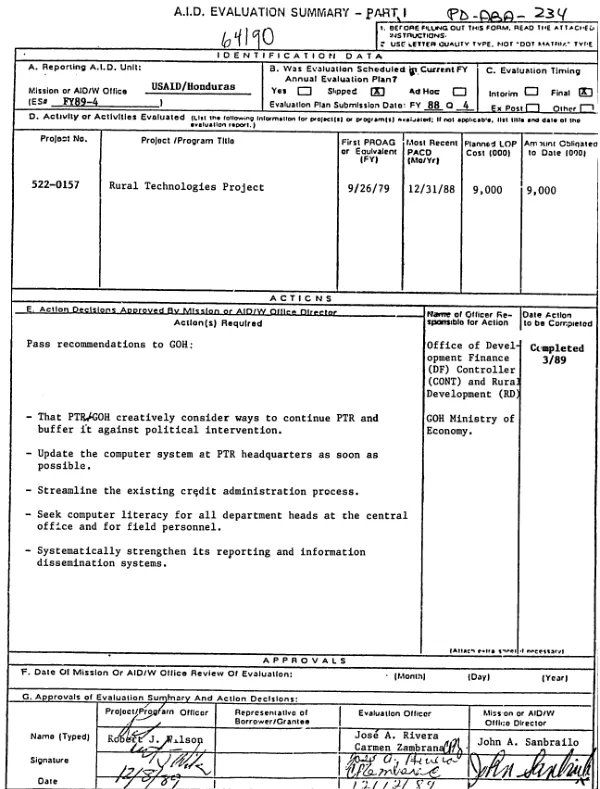
Summarizes final evaluation (PD-AAZ-146) of the Rural Technologies Project (PTR), which began in late 1979 with the purpose of increasing the use of light, appropriate technologies in farms and rural enterprises of Honduras.
1988
Sign in to readA free account is required to download.
Abstract
It was designed as a cooperative effort between the Industrial Development Center of the Ministry of Economy and the Development and Adaptation Unit (UDA) of the Ministry of Natural Resources. Several other institutions were also structured into the project at the time for training, documentation, and dissemination of information on technologies. In late 1984, the project adapted the Farming Systems Research and Extension (FSR/E) approach to its activities in the field. The number of technologies disseminated declined immediately following the introduction of FSR/E, but later it rose substantially. The new approach ultimately enabled the project to focus its efforts on real recipient needs, thereby facilitating dissemination. Much of the project"s success from 1986 forward is attributable to FSR/E efforts. Four persons conducted the evaluation, each in charge of the following four areas: economics and credit, institutions, technologies, and private voluntary organizations. The evaluation was done through a review of documents, interviews with project implementors and beneficiaries, and field trips. The evaluation showed that the project has been reaching its intended target groups, with 23,932 families and 447 enterprises as direct beneficiaries. The most successfully disseminated technologies include veterinary techniques, domestic stoves, soil and water conservation techniques, silos, corn shellers, and innovations in cropping systems and cultivars. Despite its brief experience in credit management, the project has recovered more than 90% of its scheduled payments. However, the credit component is not yet self-sustaining. On the economic side, the average gain from project technologies was about L202 ($101) between 1980 and 1985, and L230 ($115) in the latter stages of the project. Between 1980 and 1989, the benefit cost ratio with no diffusion has been estimated at 1:4. In economic terms, the project has been successful. And, while Government of Honduras institutions have not been changed in any dramatic or sustainable way with respect to successful management of technology projects, the participation of PVO"s has been fruitful, and enabled the project to extend its coverage. (Author abstract)