USAID. MISSION TO HONDURAS
Project close-out report : Honduras rural technologies project, 522-0157
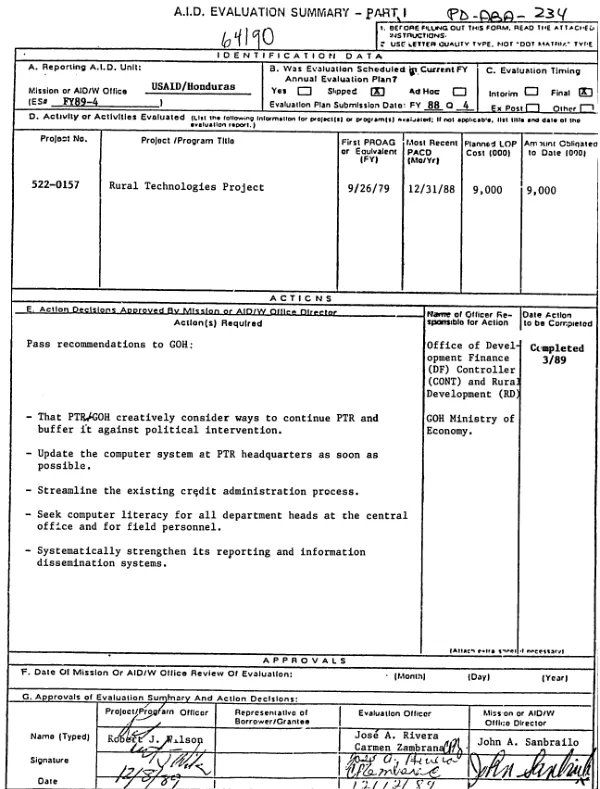
PACR of a project (9/79-12/88) to increase the access of rural households and industries in Honduras to new and improved technologies.
Falck, Emil · 1992
Sign in to readA free account is required to download.
Abstract
The project was a resounding success, exceeding its numerical targets in all major output categories (e.g., enterprises assisted, farmers benefitted, jobs generated, homes improved), and reaching some 158,000 direct and indirect beneficiaries (6% of Honduras' rural population). By adopting the farming systems methodology (FSM) in 1984, the project was able to focus its efforts in the most profitable areas for mass dissemination of appropriate technologies. Its activities were economically successful as well, with a cost/benefit ratio of 1:1.39. The average income increase per beneficiary was $195.00 a year. The project also generated several lessons learned. These are some of the most important ones. (1) The number of public sector implementing agencies should be as few as possible to avoid problems of coordination and destructive political interventions. Both project sustainability and staff continuity depend on safety from political intrusions. In this case, it should have been required as a condition precedent that the Government of Honduras (GOH) specify how it would buffer the project from such intrusions. (2) A project should not divorce financial from administrative authorities. The project unit for technology adaptation (UDA) was located within the Ministry of Natural Resources (MNR), but financially dependent on the project, leading to tensions and conflicts among the various parties. (3) Most projects that link credit and technological change have failed; this one succeeded because it used FSM, which allowed farmers to have a voice in the design of technologies, and to a large extent, in the design of the credit program. (4) While PVOs/NGOs increased project outreach, future contracts should ask that PVO/NGO technical staff be trained in accounting, computer use, and technology transfer practices. PVO/NGO efforts would also have benefitted from financial links with umbrella organizations such as FOPRIDEH and ANDI/PYME. In the area of technology development and transfer, the project teaches that early use of professional social analyses can help to identify technologies that are wanted and needed by the target population. Future technology design should closely attend to features that characterize this project's successes: affordability; life quality enhancement; risk reduction; comprehension and ease of access; income generation; good fit with existing farming and wage-labor patterns; and readily visible results. In addition, future technology generation/dissemination projects should learn from this project's flexibility, openness to user feedback, habit of building upon local practices and technologies, and use of existing socioeconomic organizations when possible. Finally, several lessons are associated with the project's adoption of FSM in 1984. The FSM process of beneficiary-based testing, which may take 1-3 years, conflicts with USAID's conventional way of setting numerical goals which must be achieved in yearly steps. The staff of conventional projects face too much pressure to meet these quotas, and often pursue them with reckless desperation (as happened during the first 5 years of this project). The returns from FSM are low in the short-term, but rise dramatically after 3 years -- technologies based on beneficiary participation spread quickly without much extension work. Staff training is very important in FSM, as is ongoing monitoring and impact evaluation. Since the project ended in 12/88 the GOH has continued to finance some of its activities as a rural technologies program which assists rural small industries and enterprises only. Rural households and small farmers are assisted by several USAID/MNR projects.
Related documents