USAID. MISSION TO KENYA
Rural women"s extension
Evaluates project to provide extension services in agricultural and income-generating activities to rural women in Kenya"s arid and semiarid zones.
Mullei, Maria; Jackson, Robert M. +1 more · 1985
Sign in to readA free account is required to download.
Abstract
Final PES covers the period 9/80-9/84 and is based on an attached special evaluation (XD-AAP-643-A) which included document review, structured interviews with PCV"s, counterpart personnel, and beneficiaries, and visits to 16 of the project"s 34 sites. Despite an implementation delay of over a year due to lagging PCV recruitment and vehicle purchases, the project should reach 10,000 (vs. a targeted 8,400) women in 32 districts by its late 1985 completion date, providing quality extension in agricultural and income-generating activities, e.g., vegetable growing, beekeeping, handicrafts. Its primary impact has been in providing a source of cash income, but other positive results include financial and labor savings, provision of nutritional foods, and wage employment creation. PCV"s have helped women"s groups accumulate assets and obtain funds from other resources, especially donor agencies. Lack of baseline data precludes precise measurement of the project"s impacts, however. The project has also provided inservice training to PCV"s and Kenyan extension personnel and has developed individualized needs assessments instruments. Although the planned home economics pamphlets were not produced, how-to materials on such subjects as beekeeping and brickmaking have been provided in lieu. Also, 10 (vs. a targeted 6) models for integrating women into all rural extension systems have been or are being produced. Increased national and global interest in women in development has aided the project; three, not one, Kenyan ministries have been involved, as have community leaders. The project has shown that activities such as beekeeping and water jar construction, because they present few labor demands, should be encouraged as means of providing the poor with income as well as basic needs. Too often poor women do not join extension groups because of the labor costs of participation are too high or they drop out during planting and harvesting seasons, or during times of environmental stress (drought, famine). For security reasons, no activities were conducted in North East Province. Action decisions are to revise the project work plan, and correspondingly the budget, to ensure project completion.
Related documents
Documents in this collection
 1984
1984USAID DEC
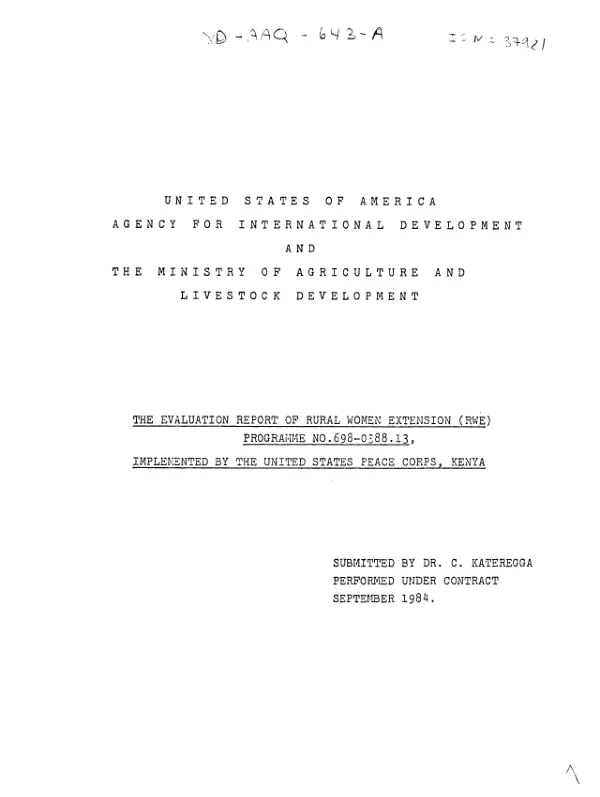
Evaluation report of rural women extension (RWE), programme no. 698-0388.13, implemented by the United States Peace Corps, Kenya
Open record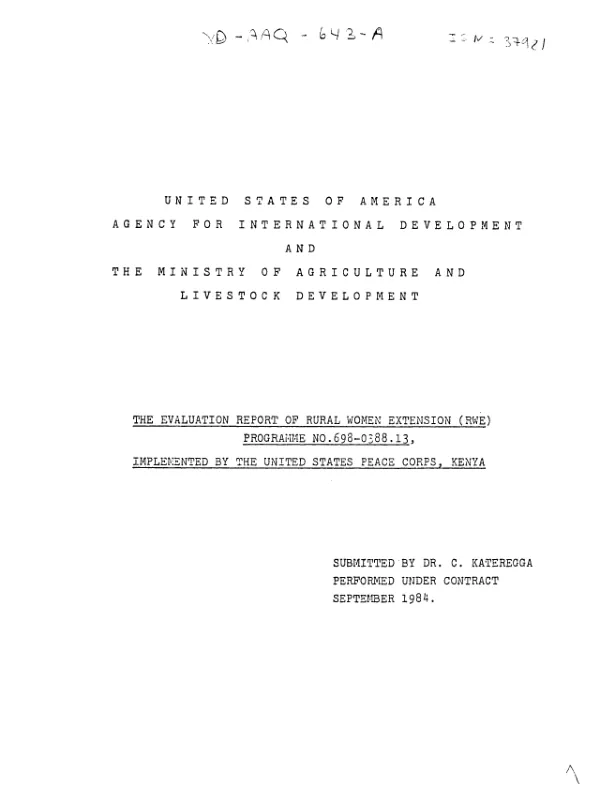 1984
1984USAID DEC