MANAGEMENT SCIENCES FOR HEALTH
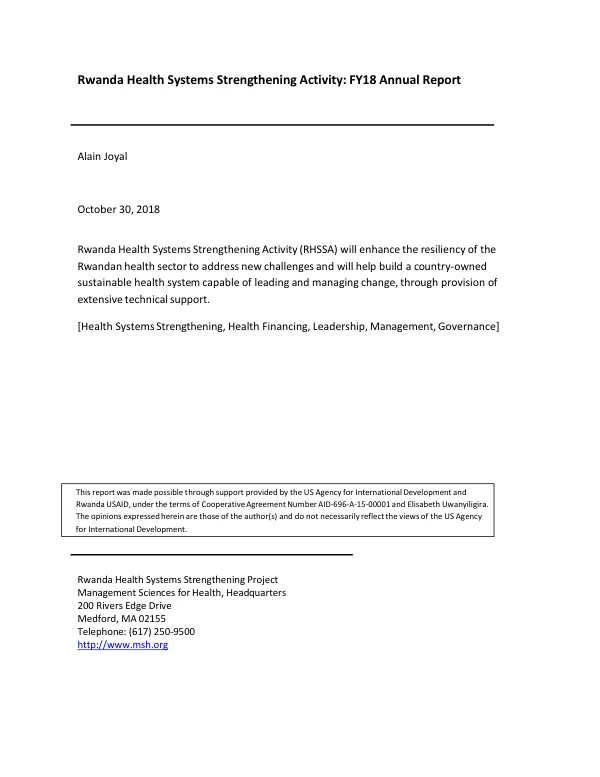
Rwanda Health Systems Strengthening Activity: FY18 Annual Report
The Rwanda Health Systems Strengthening Activity (RHSSA) aims to enhance the resiliency of the Rwandan health sector to address new challenges and build a country-owned sustainable health system capable of leading and managing change.
2018 · 87 pages
Sign in to readA free account is required to download.
Abstract
The activity provides extensive technical support to achieve this goal. Strategic Component 1: Leadership and Advocacy in Health Systems Strengthening focuses on institutionalizing health systems thinking, approaches, and practices to strengthen structural and process attributes towards increased advocacy, leadership, and stewardship. This component identifies and redresses structural and process barriers to enhance leadership and stewardship at various levels. It also increases understanding and practice of health systems strengthening at all levels as a bedrock of successful health-sector performance. Strategic Component 2: Governance, policy, and planning aims to improve multi-level GOR policy, planning, and implementation capacity with broad-based participation, and district health decentralization plan effectively implemented. This component strengthens national- and district-level capacity for planning and establishing linkages between strategic planning, budgeting, and resource use. It also increases multi-sectoral participation in policy, strategy, and implementation plans at central and decentralized levels. Strategic Component 3: Management, coordination, and implementation focuses on increasing revenue mobilized by the health sector through domestic and private sector sources to achieve sustainability. This component improves the functioning and sustainability of an integrated and equitable health insurance system. It also strengthens the capacity of the Ministry of Health to analyze economic and financial feasibility of health system interventions and devise appropriate financial options. Strategic Component 4: Monitoring and learning aims to improve M&E, health systems research, learning, and knowledge-based practices. This component develops, strengthens, and implements M&E frameworks at central and district levels. It also streamlines data production, converts data to relevant information and knowledge products, and increases evidence-based decision-making and practices at strategic and management levels. The RHSS Project Annual Report highlights key achievements in various areas, including leadership and advocacy, governance, policy, and planning, management, coordination, and implementation, and monitoring and learning. The report also presents results from various studies, surveys, and assessments conducted during the reporting period. The project has made significant progress in strengthening the Rwandan health system, including improving leadership and advocacy, governance, policy, and planning, management, coordination, and implementation, and monitoring and learning. The project has also supported the development of various health systems strengthening initiatives, including the Community-based Health Insurance (CBHI) program and the Integrated Health Insurance System (iFMIS). The RHSS Project has also supported the development of various health systems research initiatives, including the Rwanda Health Systems Research Network (RHSRN) and the Health Systems Research and Development (HSRD) program. The project has also supported the development of various knowledge management initiatives, including the Health Systems Knowledge Platform (HSKP) and the Health Systems Research and Development (HSRD) knowledge portal. The RHSS Project has also supported the development of various capacity building initiatives, including the Capacity Building Plans (CBP) and the Health Systems Strengthening Capacity Building Program (HSSCBP). The project has also supported the development of various health systems strengthening initiatives, including the Health Systems Strengthening Initiative (HSSI) and the Health Systems Strengthening Program (HSSP).