MANAGEMENT SCIENCES FOR HEALTH
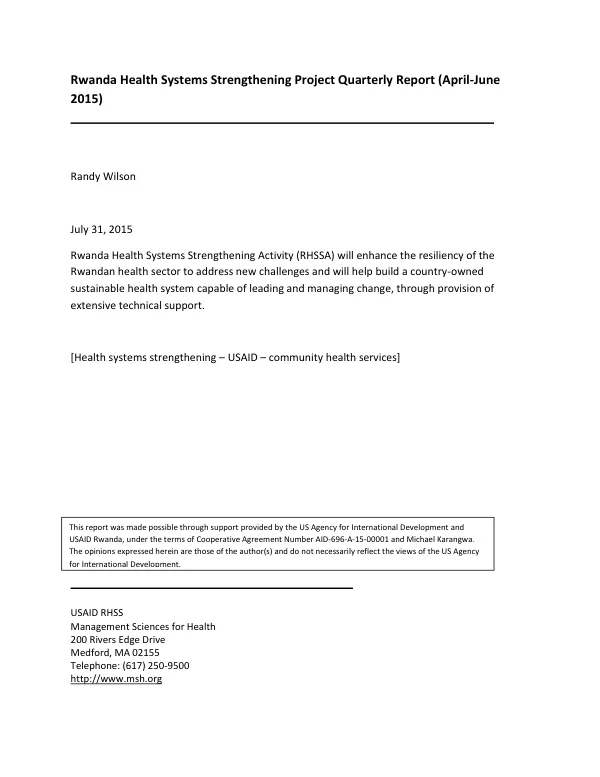
Rwanda Health Systems Strengthening Project Quarterly Report (April-June 2015)
The Rwanda Health Systems Strengthening (RHSS) project aims to enhance the resiliency of the Rwandan health sector to address new challenges and build a country-owned sustainable health system.
2015 · 39 pages
Sign in to readA free account is required to download.
Abstract
The project was awarded by the US Agency for International Development (USAID) to Management Sciences for Health (MSH) on November 17th, 2014. Over a period of five years, RHSS will provide extensive technical support to help build a sustainable health system capable of leading and managing changes. In the area of leadership, governance, and decentralization, the project completed a baseline assessment of ten districts and selected health units and facilities. This assessment aimed to identify the current state of health systems in these areas and provide a foundation for future interventions. Additionally, the project provided support to the Planning, Health Financing, and Information System (PHFIS) Technical Working Group (TWG), the Joint Sector Review (JSR), and the Health Systems Working Group (HSWG). These groups play a crucial role in shaping the country's health systems and policies. The project also made significant progress in increasing revenue mobilization by the health sector. An integrated and equitable health insurance system was improved, with a focus on sustainability. The capacity of the Ministry of Health/Rwanda Biomedical Center (MOH/RBC) to carry out economic analyses and financial feasibility of health system interventions was strengthened. Furthermore, the project increased the income generation capacity of various local entities toward staff retention and self-sufficiency. In the area of improved and expanded quality health services, the project reviewed service packages for public and private health facilities. This review aimed to ensure that services are aligned with national standards and meet the needs of the population. The project also established a healthcare accreditation organization and made progress in hospital accreditation. Capacity building for accreditation facilitators was also conducted to ensure that they have the necessary skills to support the accreditation process. The project also made progress in improving monitoring and evaluation (M&E), culture of learning, and knowledge-based practices. Data production, conversion, and increased evidence-based decision making and practices were strengthened. Operational health system research was also supported for sustainable health systems strengthening. Cross-cutting support was provided to ensure that all project activities are aligned with the overall goal of building a sustainable health system. In terms of project management and administration, the project recruited new staff and developed a five-year strategic plan. A project year 2 work plan was also developed, outlining the activities and interventions for the upcoming year. Detailed program descriptions for RHSS sub-contractors were also developed to ensure that all project activities are implemented effectively. Overall, the RHSS project made significant progress in the second quarter of 2015, with a focus on building a sustainable health system capable of leading and managing changes. The project's activities and interventions are aligned with the overall goal of improving the health outcomes of the Rwandan population.
Related documents