USAID DEC
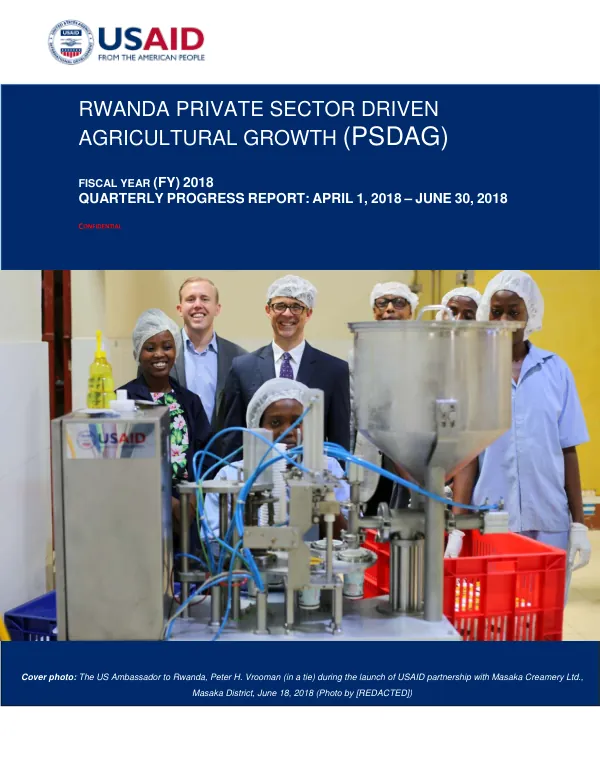
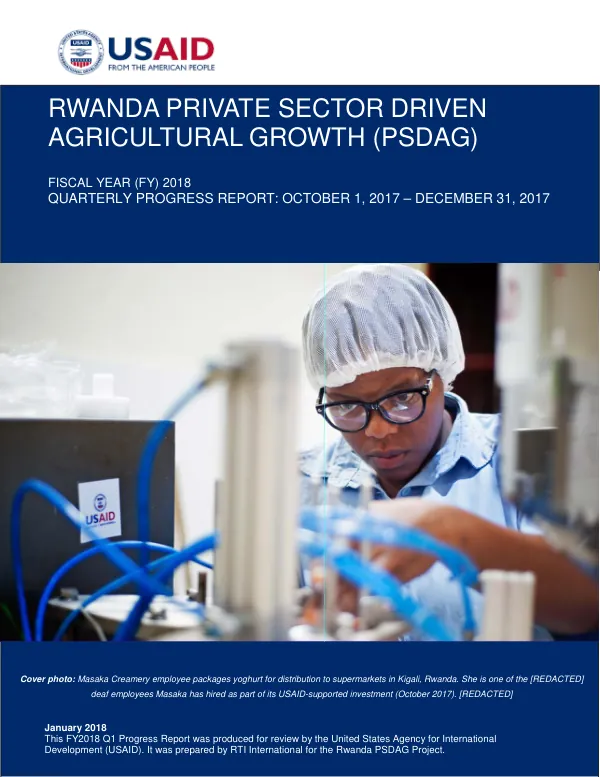
Rwanda Private Sector Driven Agricultural Growth (PSDAG) Project FY2018 Q1 Progress Report
Sign inRTI INTERNATIONAL
Rwanda Private Sector Driven Agricultural Growth (PSDAG) Project FY2018 Q1 Progress Report
The Rwanda Private Sector Driven Agricultural Growth (PSDAG) Project is a USAID-funded initiative aimed at increasing private sector investment in Rwanda's agricultural sector.
2018 · 125 pages
Sign in to readA free account is required to download.
Abstract
The project's primary objective is to assist the Government of Rwanda (GOR) in increasing private sector investment, with a focus on upgrading value chains. Implementation of Objective 1.1, which involves assisting the GOR to increase private sector investment, has been underway since the project's inception. Key milestones and partnerships have been established, including the selection and approval of private partners. Activities under this objective include the provision of technical assistance to private sector partners, capacity building, and the facilitation of partnerships between the private sector and government institutions. The project has also made significant progress in facilitating increased private sector investment to upgrade value chains. Selection and approval of private partners have been completed, and activities are underway to support the development of value chains. Partnerships have been established with various organizations, including the Development Bank of Rwanda, Kenya Commercial Bank Rwanda, and the Access to Finance Rwanda. Monitoring and evaluation are critical components of the project, with a focus on tracking progress and identifying areas for improvement. The FY2018 M&E Plan outlines the project's monitoring and evaluation framework, including performance tracking and reporting, capacity building for private sector partners, and the use of information and communication technology (ICT). Social inclusion is also a key cross-cutting theme, with activities aimed at promoting the participation of women, youth, and people with disabilities in the agricultural sector. Capacity building and knowledge management are essential components of the project, with a focus on building the capacity of PSDAG staff and private sector partners. Partnerships have been established with various organizations, including the Hollanda FairFoods, Shekina Enterprises, and Tuzamurane Cooperative, to support the development of the agricultural sector. Environmental compliance is also a key consideration, with activities aimed at promoting sustainable agricultural practices and reducing the environmental impact of agricultural activities. The project has established partnerships with various organizations, including the Development Bank of Rwanda, Kenya Commercial Bank Rwanda, and the Access to Finance Rwanda, to support the development of the agricultural sector. These partnerships have been established to facilitate the provision of technical assistance, capacity building, and the facilitation of partnerships between the private sector and government institutions. The project has also made significant progress in supporting the development of value chains, with a focus on upgrading the quality and efficiency of agricultural products. Partnerships have been established with various organizations, including the Hollanda FairFoods, Shekina Enterprises, and Tuzamurane Cooperative, to support the development of value chains. These partnerships have been established to facilitate the provision of technical assistance, capacity building, and the facilitation of partnerships between the private sector and government institutions. The project's progress has been monitored and evaluated through a range of indicators, including the number of private sector partners supported, the value of investments made, and the number of jobs created. The project's impact has been significant, with a focus on promoting economic growth, reducing poverty, and improving food security in Rwanda.
Related documents