USAID DEC
Rwanda small marais development study : investigations into the agronomy of two small marais -- Nyarutovu and Ilibunga
Sign inCORNELL UNIVERSITY. NEW YORK STATE COLLEGE OF AGRICULTURE AND LIFE SCIENCES. DEPT. OF AGRONOMY
Rwanda small marais development study : investigations into the agronomy of two small marais -- Nyarutovu and Ilibunga
The term "marais" in Rwanda has been used to characterize any seasonally or permanently inundated valley or depression with alluvial soils, which may or may not be organic.
Lefrancois, Marie Pierre; Duxbury, John M. · 1987
Sign in to readA free account is required to download.
Abstract
Small marais, as opposed to their larger counterparts in the flood plains, are found scattered throughout the country with a high concentration in the Central or High Plateau region of Rwanda. The marais have long been considered a last resort for expanding cultivated acreage in landlocked Rwanda, which is facing problems of overpopulation and land shortage and fragmentation. Most marais are now cropped, and access to plots is controlled at the communal level, since land is under state ownership. Few development schemes in the past have been concerned with soil characterization and existing cropping systems in small marais. Most have dealt with hydrologic aspects such as drainage and irrigation, although with relative success. There is thus a need to gain some insight into the nature and importance of soil constraints in smail marais and their effects on the efficiency of existing cropping systems. This paper reports on research conducted in Rwanda from July 3 through November 15, 1987, in order to characterize the fertility of the soils of two small marais and to relate fertility and soil water parameters to the performance of the traditional cropping system, sweet potatoes (Ipoomoea batatas) on raised beds. Secondary objectives were to evaluate fertilizer response and assess growth of alternative crops on marais soils. The main body of the report comprises three sections: the first contains background information on the two marais studied, the second describes in detail the crop-soil-water system study and the third outlines the fertilizer trials. (Author abstract)
Related documents
Documents in this collection
 2012
2012USAID DEC
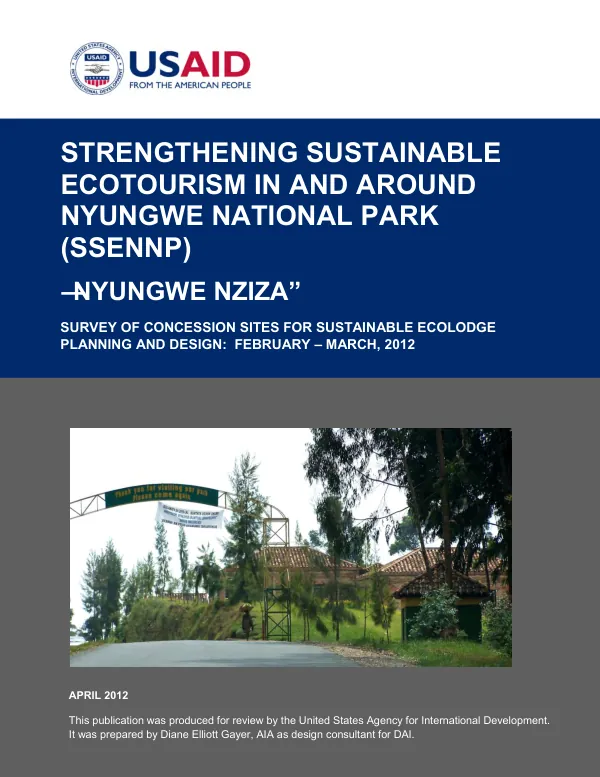
Strengthening sustainable ecotourism in and around Nyungew National Park (SSENNP) : Nyungwe Nziza -- survey of concession sites for sistainable ecolodge planning and design, February to March , 2012
Open record 1970
1970USAID DEC