USAID DEC
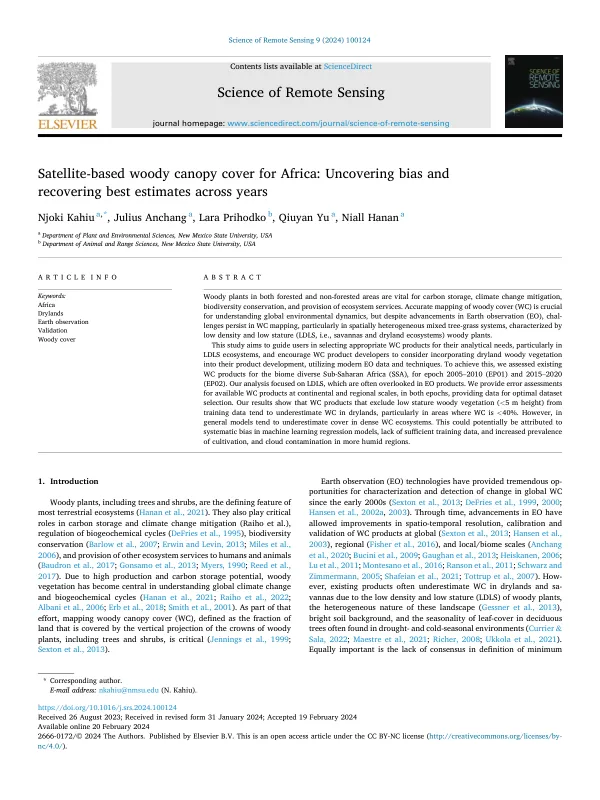
Satellite-based woody canopy cover for Africa: Uncovering bias and recovering best estimates across years
Sign inNEW MEXICO STATE UNIVERSITY
Satellite-based woody canopy cover for Africa: Uncovering bias and recovering best estimates across years
Woody plants, including trees and shrubs, are the defining feature of most terrestrial ecosystems.
2024 · 16 pages
Sign in to readA free account is required to download.
Abstract
They play critical roles in carbon storage and climate change mitigation, regulation of biogeochemical cycles, biodiversity conservation, and provision of ecosystem services to humans and animals. Accurate mapping of woody canopy cover (WC) is crucial for understanding global environmental dynamics. However, challenges persist in WC mapping, particularly in spatially heterogeneous mixed tree-grass systems, characterized by low density and low stature (LDLS) woody plants. The term WC has several near-synonymous terms, including forest canopy cover, forest density, fractional forest canopy, fractional tree cover, percent tree cover, tree crown cover, tree canopy cover, and foliage projective cover. For consistency, WC metrics representing the fraction of land covered by the vertical projection of the crowns of woody plants, including both trees and shrubs, are referred to as percentage woody canopy cover (WC). WC products and their derivatives are widely used in various applications, including analysis of change in woody cover, carbon emission, land fragmentation analysis, vegetation characterization, and biomass estimation. Several validation efforts have been implemented to assess the usability of Earth observation (EO) derived WC. Moderate Resolution Imaging Spectroradiometer (MODIS) vegetation continuous fields percent tree cover (MVCF) data has one of the longest time-series and is one of the most widely used datasets in the global EO community. However, validation results point to the tendency of MVCF and Landsat vegetation continuous field percent tree cover (LVCF) to underestimate WC in LDLS biomes, particularly drylands. Furthermore, numerous continental and global scale EO products tend to focus validation efforts in forested ecosystems, creating a critical gap in our understanding of their performance in LDLS ecosystems. This study aims to guide users in selecting appropriate WC products for their analytical needs, particularly in LDLS ecosystems, and encourage WC product developers to consider incorporating dryland woody vegetation into their product development. To achieve this, existing WC products for the biome diverse Sub-Saharan Africa (SSA) were assessed for two epochs (2005-2010 and 2015-2020). The analysis focused on LDLS, which are often overlooked in EO products. Error assessments were provided for available WC products at continental and regional scales, in both epochs, to provide data for optimal dataset selection. The results show that WC products that exclude low stature woody vegetation (<5 m height) from training data tend to underestimate WC in drylands, particularly in areas where WC is <40%. However, in general, models tend to underestimate cover in dense WC ecosystems. This could potentially be attributed to systematic bias in machine learning regression models, lack of sufficient training data, and increased prevalence of cultivation, and cloud contamination in more humid regions. The study underscores the pressing need for improvement in WC estimates for often-overlooked LDLS ecosystems.