TEXAS A&M INTERNATIONAL UNIVERSITY
Limited Penetration of Governance and Conflict in Sub-Saharan Africa
The study investigates the penetration of governance structures in sub-Saharan Africa in the context of conflict.
2014 · 27 pages
Sign in to readA free account is required to download.
Abstract
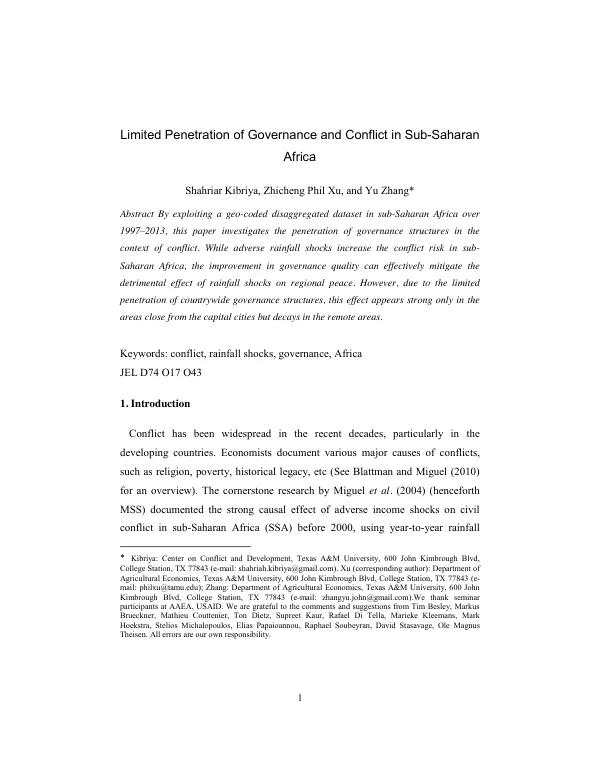
Adverse rainfall shocks increase the conflict risk in the region, but the improvement in governance quality can effectively mitigate this effect. However, the countrywide governance quality affects the relationship between rainfall shocks and conflict risk only in areas close to the capital cities, with the effect decaying in remote areas. The researchers exploit a geo-coded disaggregated dataset in sub-Saharan Africa over 1997-2013 to estimate the impact of rainfall shocks on conflict risk conditional on governance quality. The study highlights the importance of governance quality in mitigating civil conflict upon adverse weather shocks in the region. The researchers also investigate the heterogeneous effect of governance quality associated with the distance to the capitals, uncovering the limited penetration of institutional structures in remote areas. The study contributes to the literature on the relationship between weather shocks and conflict, as well as the role of institution in the context of conflict in sub-Saharan Africa. The researchers use a comprehensive disaggregated dataset to improve understanding of these open questions, circumventing the limitations of previous studies that exploited either country-level datasets or country case studies. The data used in the study consists of 1742 cells from 44 sub-Saharan African countries over the period of 1997-2013. The panel structure of the data allows for control of pixel-level heterogeneity and conflict evolution over years. Descriptive statistics are reported in Table 1, which shows the prevalence of conflicts in sub-Saharan Africa. The study also uses data from the Climate Research Unit (CRU) to measure rainfall. The researchers collect geo-referenced data and assign them to each cell, creating a comprehensive dataset for analysis. The study's findings have implications for understanding the role of governance in mitigating conflict in sub-Saharan Africa, particularly in remote areas where institutional structures have limited penetration. The study's methodology involves estimating the impact of rainfall shocks on conflict risk conditional on governance quality. The researchers use a range of variables, including conflict indicators, rainfall data, and governance quality measures. The study's results show that the effect of countrywide governance quality on the relationship between rainfall shocks and conflict risk decays in remote areas. The study's conclusions have important implications for policymakers and researchers seeking to understand the complex relationships between governance, conflict, and weather shocks in sub-Saharan Africa. The findings highlight the need for targeted interventions to improve governance quality in remote areas, where institutional structures have limited penetration.
Related documents