SAVE THE CHILDREN (U.S.)
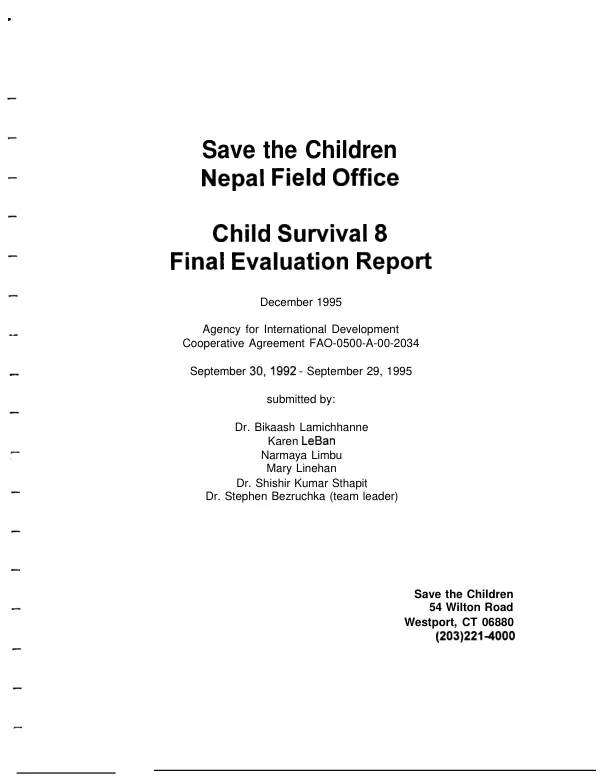
Save the Children, Nepal field office : Child survival 8 -- final evaluation report
Final evaluation of a child survival project (10/92-9/95) implemented by Save the Children Federation (SCF) in Nepal"s Nuwakot District, northwest of Kathmandu.
Lamichhanne, Bikaash; LeBan, Karen · 1995
Sign in to readA free account is required to download.
Abstract
The project started in 10/92, in a new area for SCF, without major difficulties; the site was chosen because of concern about "girl trafficking," which was reported to be a major economic activity. The project"s strategy was to empower communities to demand better health services from the government. Its major activity was literacy classes for women, leading to group formation and income generating efforts. Health education was introduced indirectly, through nonformal education (NFE). Government health services were supplemented by project mobile maternal/child health (MCH) clinics, and immunization catch-up rounds. The project has demonstrated the strength of literacy as an intervention. Although most targets were not reached, progress was remarkable, with 10 of 16 indicators showing substantial positive change. Particularly notable were the numbers of new literates and women"s groups. There was indirect evidence of nascent empowerment, but no evidence of change in provision of government health services. The major effect of the project, perhaps underappreciated by the staff, is the wide communication network produced by NFE and the resulting group formation; this network is responsive to SCF-influenced NFE facilitators, supervisors, and class participants. The major concern is that impacts have been the lowest among the Tamang, the area"s predominant ethnic group; the Tamang are among the most economically disadvantaged in Nepal, and are the presumed focus of the trafficking activity. Project staff need to make a more serious attempt to understand the Tamang and their relative lack of involvement in NFE. Also, staff might consider living more closely with the community. Other lessons and conclusions from the project include the following. (1) Training local NFE facilitators is practical and sustainable. (2) One cannot assume that proximity to Kathmandu is an indicator of receptivity to modern ideas and values. (3) NFE may not work as a strategy for influencing government health services. Strong, motivated individuals in the government health system should be the focal point of trying to improve services. (4) Behaviors and patterns associated with girl trafficking are difficult to assess; project interventions were not closely linked with the practice and thus had little impact on it. (5) Jobs empower women in the eyes of the community, at least among Hindu caste groups. (6) Prenatal care may not be acceptable to many people in the area, the birthing kit does not make economic sense to many people, and there is not a significant demand for traditional birth attendants, at least among the Tamang. (7) IEC materials are not effective behavioral change agents, especially among nonliterate populations. (8) Geographic economics may be a major factor in sexually transmitted disease epidemiology in the region. (9) Female community health volunteers (FCHVs) are a poorly understood work force in the project area; staff need to spend more time working with FCHVs to help them realize their potential. (10) Most importantly, formative qualitative study should guide program development.
Related documents