USAID. BUR. FOR POLICY AND PROGRAM COORDINATION. CENTER FOR DEVELOPMENT INFORMATION AND EVALUATION (CDIE)
Saving energy in Guatemala
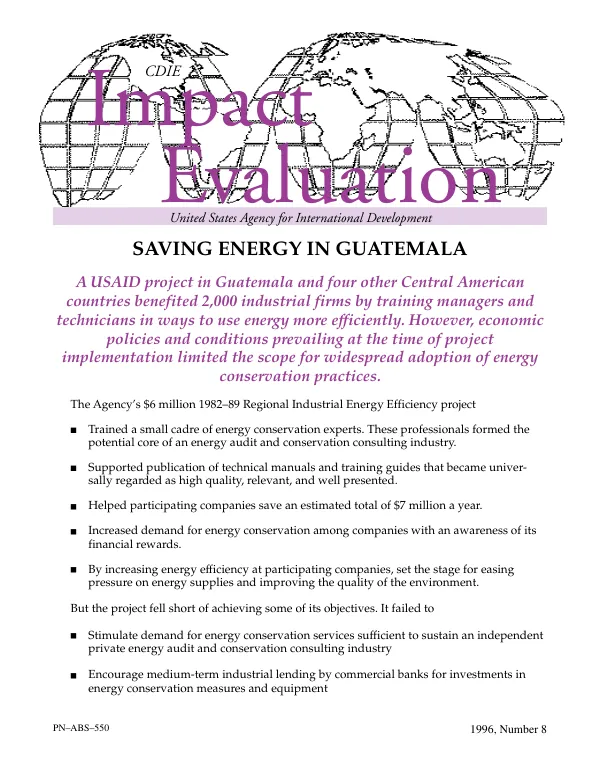
USAID"s Regional Industrial Energy Efficiency project benefited 2,000 industrial firms in Guatemala and four other Central American countries by training managers and technicians in ways to use energy more efficiently.
Church, Phillip E.; Leibson, David +1 more · 1970
Sign in to readA free account is required to download.
Abstract
However, economic policies and conditions prevailing at the time limited the probability of widespread adoption of energy conservation. This evaluation addresses impacts both in Central America as a whole and specifically in Guatemala. The project trained a small cadre of energy conservation experts, who could potentially form the core of an energy audit and conservation consulting industry; supported the publication of technical manuals and training guides that are universally regarded as high quality, relevant, and well-presented; and helped participating companies save an estimated total of $7 million a year. The project emphasized inexpensive measures such as repairing leaks and installing insulation. Because the project helped to increase energy efficiency and reduce use, it has quite probably had beneficial environmental effects as well. However, the project was unable to stimulate enough demand for energy conservation services to sustain an independent private energy audit and conservation consulting industry, or to encourage medium-term industrial lending by commercial banks for investments in energy conservation measures and equipment. The following lessons were learned. (1) Education and awareness are critical to promoting industrial energy conservation. In Guatemala, seminars and workshops informed engineers about energy auditing services and provided them with technical information for improved energy management. (2) Unfortunately, the project gave only modest attention to energy price policy issues; energy conservation discipline flows as much from price incentives as from knowledge and awareness. Cheap, if not always reliable, fuel and power supplies offer little incentive to follow responsible energy management practices. (3) Energy auditing can be a bridge to environmental auditing; industrial companies that participate in energy audits and adopt recommendations frequently move on to address broader environmental problems (e.g., solid-waste management, wastewater treatment) that also benefit their cost performance and lead to a cleaner environment. (4) Project personnel and participants can form the basis of a constructive network for advancing energy conservation after project funding ends. Of the 30 to 40 local project staff, a few have moved on to become independent energy auditors and conservation consultants while others continue as energy managers for industrial firms that participated in the project.
Related documents