USAID. BUR. FOR POLICY AND PROGRAM COORDINATION. CENTER FOR DEVELOPMENT INFORMATION AND EVALUATION (CDIE)
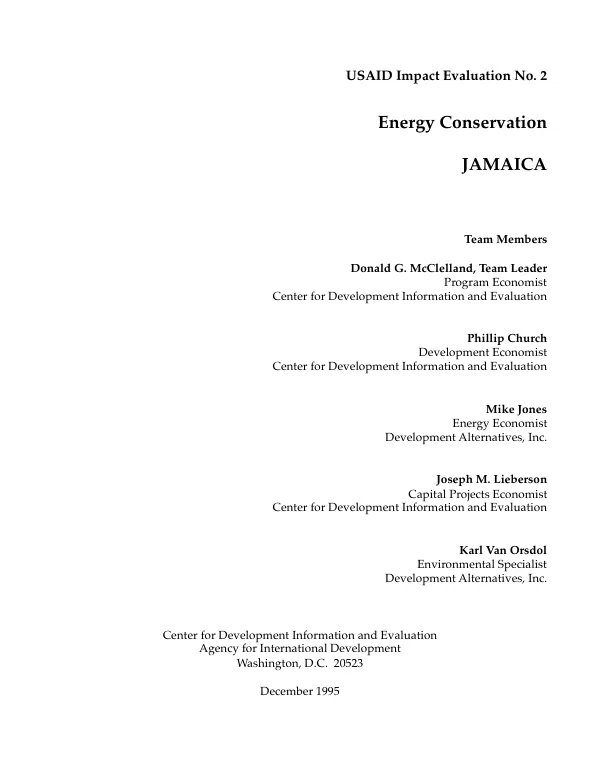
Energy conservation : Jamaica
Assesses the impact of the energy conservation component of USAID"s Energy Sector Assistance project in Jamaica (1981-85).
McClelland, Donald G.; Church, Phillip E. · 1995
Sign in to readA free account is required to download.
Abstract
The subproject, which trained energy auditors, carried out energy audits, and made energy conservation investments in both the public and private sectors, resulted in significant energy savings -- an estimated 13% in electricity usage. The payback was rapid for public sector hotels and factories, which more than recouped investments through energy savings in less than a year. Nonetheless, impact could have been much greater. The government"s cheap energy pricing policy retarded energy conservation (electricity prices were well below costs until the early 1990"s), as did its reluctance to offer tax, duty, or credit incentives to encourage conservation. Incentive to conserve energy was also reduced by the dramatic decline in oil prices in 1986. Ten years later, with petroleum prices still very low, there is only a marginal economic incentive to conserve energy, especially for industries in which energy costs are a small portion of operating costs. The project might have had a greater impact on energy consumption and achieved significant environmental benefits at the national level if it had targeted the largest companies in the most energy-intensive industries (a dozen Jamaican firms consume 75% of the country"s energy). Instead, the project targeted a large number of small firms and businesses. There is only scattered evidence of sustained or expanded energy conservation activities in the public and private sectors. There are only a few energy auditors in Jamaica today, and only a few firms market energy conservation equipment. There was little market demand from private businesses after 1986. Lessons learned include the following. (1) Absent an energy crisis, only private firms that are relatively energy-intensive will make major investments in energy conservation. (2) Successful energy conservation programs require supportive economic policies and appropriate environmental regulations. (3) A relatively short payback period, a firm"s long-term financial viability, and a positive investment climate are critical to making major investments in energy conservation. (4) Energy conservation programs are likely to perform better in a competitive economic environment in which the business culture rewards firms that reduce production costs. (5) Beneficiary commitment is critical to a sense of ownership and program sustainability. (6) Government is most effective when its role in energy conservation is limited to establishing an appropriate policy framework and providing education and information. (7) The environmental benefits of energy conservation are realized in two ways: when less fossil fuels are used to generate energy or when the same amount generates more energy.
Related documents