ABT ASSOCIATES
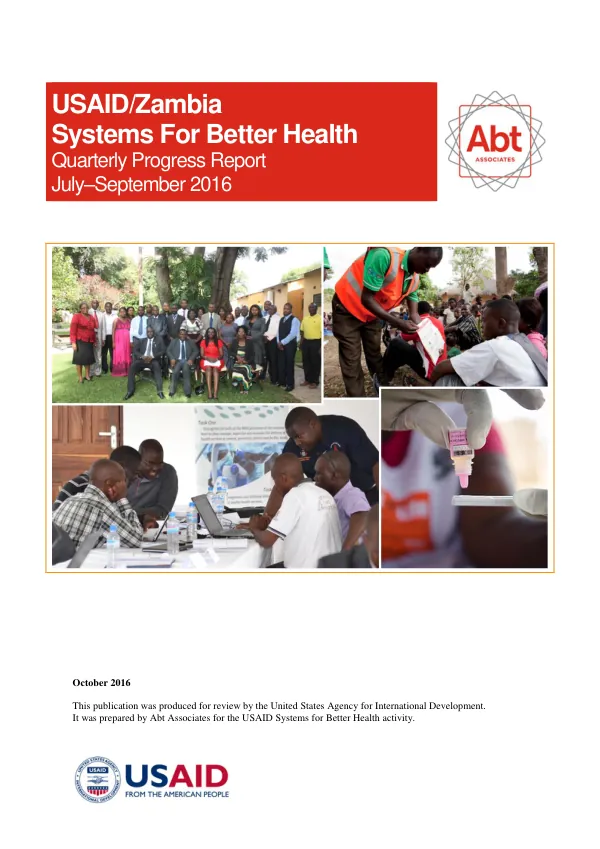
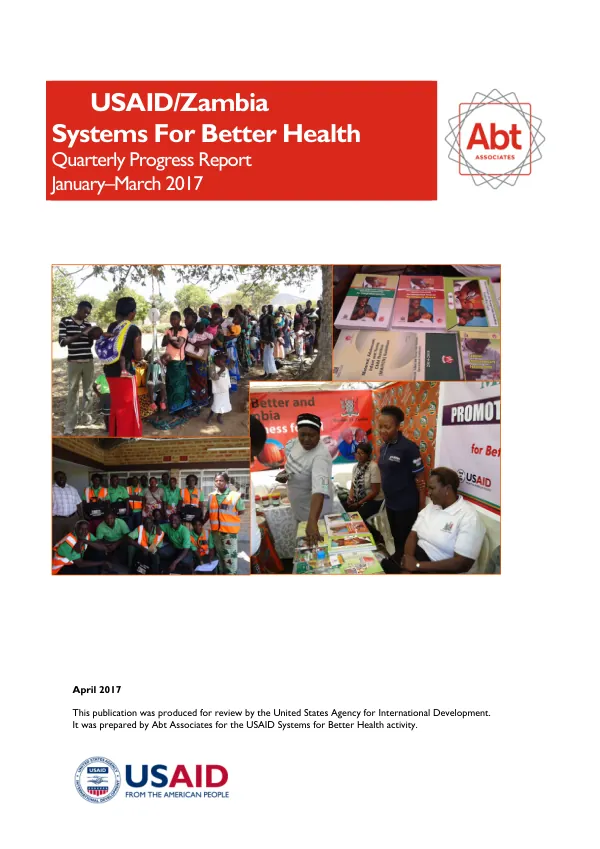
SBH Quarterly Progress Report Year 1 Quarter 1
The USAID Systems for Better Health (SBH) activity in Zambia was awarded to Abt Associates Inc.
2016 · 33 pages
Sign in to readA free account is required to download.
Abstract
in October 2015. The project aims to improve health outcomes for Zambians by strengthening systems that underpin the delivery of high-quality health services and increasing the utilization of high-impact health interventions at district and community levels. The expected outcomes of the activity are: Effective national level health stewardship; Improved health care financing and human resources planning; Strengthened capacity of the Ministry of Health to oversee delivery of health programs; Improved program management capabilities of provincial and district health teams; Increased quality, availability, and availability of priority health services at the community level in targeted districts; Increased utilization of key health interventions. The project has the following specific objectives: Retention of patients on antiretroviral therapy increased to at least 80 percent in targeted districts; Modern contraceptive use increased by 10 percent in targeted districts; Proportion of deliveries with assistance from a medically trained provider increased by 20 percent in targeted districts; At least 80 percent of children under the age of five receive all recommended vaccinations. The project is implemented in collaboration with the American College of Nurse-Midwives, Akros Inc., BroadReach Institute for Training and Education, Initiatives, Inc., Imperial Health Sciences, and Save the Children. The project team has established an office, brought 15 employees on board, and identified 17 individuals for technical and support positions. The team has also submitted six contractual deliverables on time and begun developing several other required reports. The project has made significant progress in the first quarter of operations. The team has met with the Permanent Secretary of the Ministry of Health to present the project and consult on specific features. Senior managers have also met with the majority of the Ministry of Health Directors to discuss project design and strategy. The project team has participated in three working group meetings and introduced the project to other partners. The project has also made progress in implementing its interventions. The team has begun training farmers in sustainable agriculture techniques and has established demonstration plots to demonstrate the effectiveness of the techniques. The project has also made progress in improving health care financing and human resources planning. The project has several technical areas, including: Grants under Contract; Research, Monitoring, and Evaluation; Knowledge Management; Gender; Health Care Financing; Human Resources for Health; Quality Improvement; Systems Strengthening. The project has also established a management structure, including office setup, personnel, and personnel management processes and systems. The project has also established a finance and administration system, including overall budget and expenditures. The project has several annexes, including: Annex 1: Performance Indicator Tracking Table; Annex II: Summary of Training Data; Annex III: Status of Key Deliverables; Annex IV: Short-term Assistance Plan for Next Quarter. The project has also established a system for tracking progress, including a performance indicator tracking table. The project has also established a system for monitoring and evaluating progress, including a monitoring and evaluation plan. The project has several partners, including the American College of Nurse-Midwives, Akros Inc., BroadReach Institute for Training and Education, Initiatives, Inc., Imperial Health Sciences, and Save the Children. The project has also established a system for collaborating with other partners, including a system for sharing information and coordinating activities. The project has also established a system for managing finances and administration, including a system for tracking budget and expenditures. The project has several partners, including
Related documents