MERCY CORPS INTERNATIONAL
SCALE Strengthening Capacity in Agriculture, Livelihoods and Environment
The Strengthening Capacity in Agriculture, Livelihoods and Environment (SCALE) Award is a five-year capacity strengthening, applied research and knowledge sharing initiative.
2018 · 25 pages
Sign in to readA free account is required to download.
Abstract
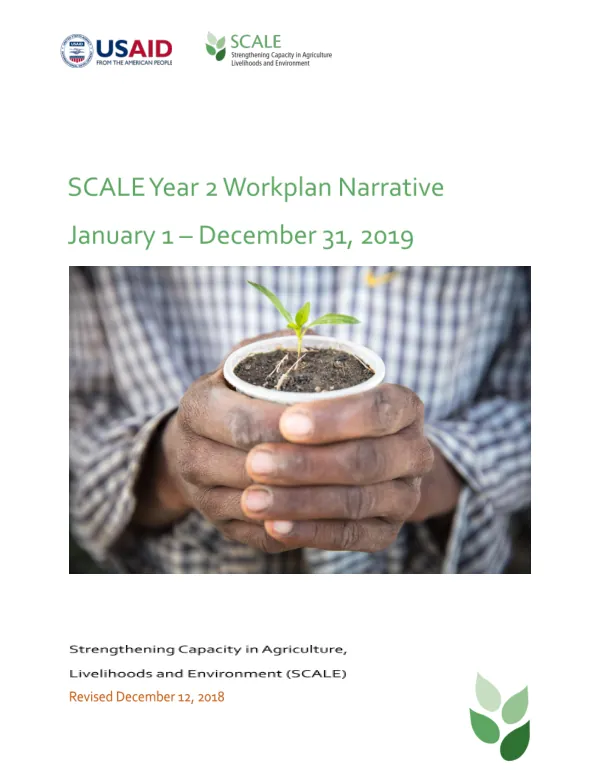
Funded by the USAID Office of Food for Peace (FFP), SCALE works to strengthen the impact, sustainability and scalability of FFP-funded agriculture, natural resource management, and off-farm livelihood activities in both emergency and development contexts. Implemented by Mercy Corps in collaboration with Save the Children, SCALE partners with food security implementers and the broader research community to capture, generate, apply and share knowledge to foster more resilient agricultural systems and enhance income opportunities for the world's most vulnerable. SCALE's strategic approach incorporates activities under four knowledge mechanisms: knowledge capture, knowledge generation, knowledge application, and knowledge sharing. The approach is revised every year as part of the adaptive management approach to ensure it remains current with FFP implementer needs. In Year 2, SCALE will continue to implement activities under these four mechanisms, including case studies and lessons learned, tested technologies, training of trainers materials and guides, and capacity strengthening opportunities for senior management and field and technical staff. The SCALE project started on January 30, 2018, and the Year 2 workplan extends from January 1 to December 31, 2019. The workplan includes adaptive management, staff hire, and adaptive program design and strategy. All full-time SCALE staff were hired in Year 1, and these positions will continue into Year 2. The Agriculture Advisor for capacity strengthening will transition from Washington, DC to Kenya in Q1Yr2. A Regional West Africa Facilitator based in Niger was hired in Q4Yr1 and will continue into Year 2. The SCALE strategic framework was finalized with input from implementers and USAID/FFP during Year 1 and will be revised in Q1Yr2. The framework incorporates a focus on the specific technical areas of agriculture, Natural Resource Management (NRM), and off-farm/non-farm livelihoods in both emergency and development contexts. Priority technical areas were identified in discussion with implementers, technical specialists and USAID/FFP, including climate, NRM and water; livestock; post-harvest; markets and finance; agriculture-nutrition; gender and agriculture; alternative livelihoods and employment; sustainability and resilience and emergency programming. In Year 2, the following technical areas will continue to emerge as priorities because of the gaps in current knowledge and/or resources and the relevance to FFP programs: climate, NRM and water – agriculture and NRM activities that build the resilience of agricultural systems to climate-related shocks and stresses and make more efficient use of water and other natural resources; emergency – agriculture and NRM in emergencies and post-crisis recovery; and off-farm/non-farm – livelihood opportunities that exist outside the farm, particularly in rural areas, or those that connect with rural areas. SCALE will continue to consult with FFP and partners to refine the areas of greatest need and urgency. The project will also pay particular attention to the integration of youth and gender considerations into all activities. Specific targets for each mechanism are presented in the performance management plan in Annex 1, and a summary of workplan activities is presented in Annex 2.
Related documents