ACDI/VOCA
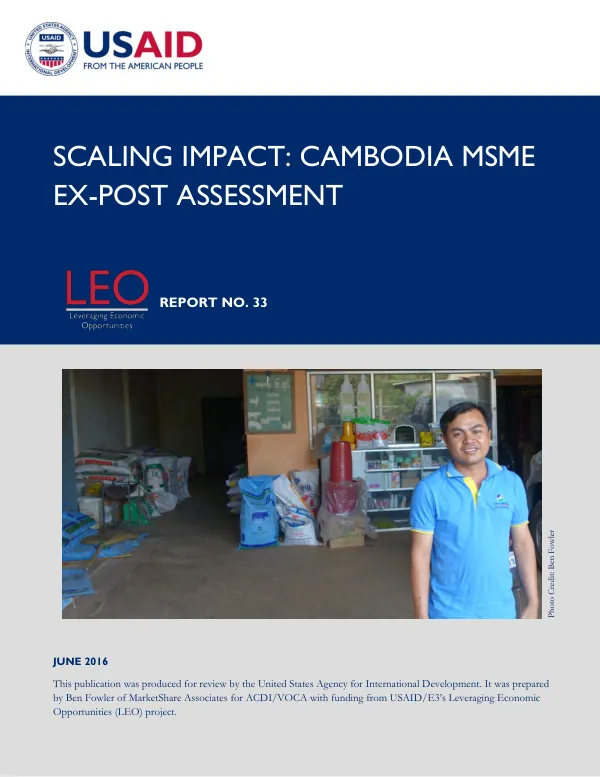
Scaling Impact: Cambodia MSME Ex-Post Assessment
The Leveraging Economic Opportunities (LEO) activity aims to increase the capacity of USAID staff and its development partners to use evidence-based good practices to design, implement, and evaluate projects that promote inclusive market development.
2016 · 28 pages
Sign in to readA free account is required to download.
Abstract
One of the research streams focuses on models for reaching scale, exploring how implementing agencies can link smallholder farmers, including the very poor, to input and output markets. The research focuses on the principles and conditions that make these models effective. The LEO program has conducted research into projects that have addressed the issues of smallholder farmers through a market systems facilitation approach. Phase 1 of this research included two desk-based reviews of 50 projects, with a more detailed study of 16 projects. The results were summarized in two papers. Phase 2 includes two field-based case studies focused on expanding the learning of priority cases from Phase 1. This report assesses the legacy of the input supply sector development activities of the USAID/Cambodia Micro, Small and Medium Enterprise (MSME) project's Phases 1 and 2. The MSME project promoted the use by the private sector of an embedded training model, in which companies would provide technical information on input selection and application at no direct charge to swine farmers in order to increase input sales. This study finds that the embedded training model has endured and even expanded since the end of the project, being used to varying extents by the majority of the firms in the sector. Only one of the 11 surveyed wholesalers that MSME worked with had discontinued its use of the model. The MSME project used a market facilitation approach, avoiding directly financing its target beneficiaries: small-scale farmers. The project's pitch to potential clients was to assist them in learning how to grow their business and facilitate introductions to other value chain actors who can help them help themselves. This approach eliminated many of the firms that lacked entrepreneurial energy. The project concentrated on identifying and working with high-potential farmers who were willing to invest in their businesses and experiment with new approaches. The MSME project carried out a wide variety of activities along the swine value chain, from improving access to quality inputs to promoting home feeding practices. The project also worked to strengthen relationships and build linkages between value chain actors, thereby improving productivity and enhancing the business enabling environment in Cambodia. This assessment focuses exclusively on the swine value chain, which contributed the majority of MSME 2's reported impact. The embedded training model promoted by MSME has become an industry norm, with new input wholesalers who launched following the end of the project also applying this model. Firms have adapted their training offering vis-à-vis the model originally promoted by MSME, and are also using other methods (e.g., direct farm visits) to provide technical information. The model has been used to varying extents by the majority of the firms in the sector, with only one of the 11 surveyed wholesalers that MSME worked with having discontinued its use of the model.