USAID DEC
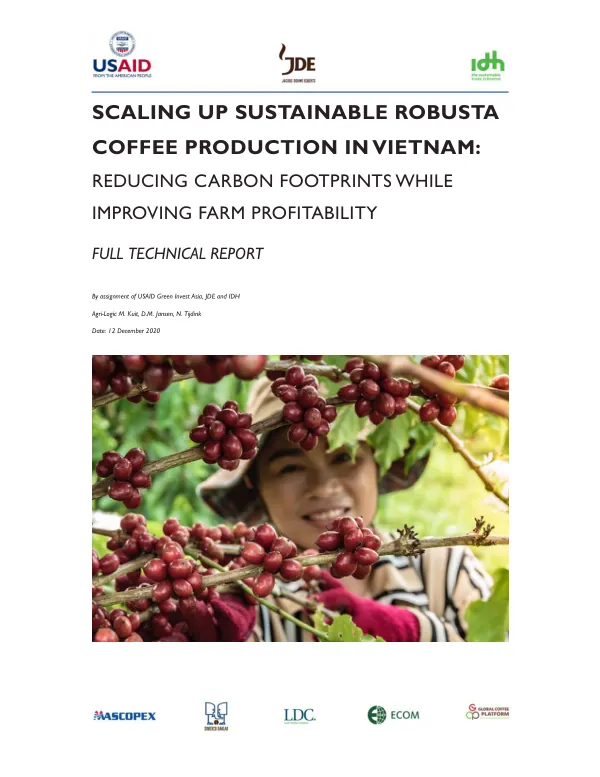
Scaling up Sustainable Robusta Coffee Production in Vietnam: Reducing Carbon Footprints While Improving Farm Profitability Full Technical Report
Sign inUSAID
Scaling up Sustainable Robusta Coffee Production in Vietnam: Reducing Carbon Footprints While Improving Farm Profitability Full Technical Report
Vietnam's coffee production is a significant contributor to the country's agricultural export earnings, with the Central Highlands region being the primary production area.
2021 · 72 pages
Sign in to readA free account is required to download.
Abstract
The region's coffee production is concentrated on approximately 565,000 hectares, with Robusta coffee being the dominant variety. Vietnam is the world's second-largest producer of coffee, accounting for around 15% of global production. The country's coffee production is characterized by a high level of monoculture, with many farms relying heavily on a single crop. This has led to concerns about the environmental impact of coffee production, including deforestation and soil degradation. In an effort to address these concerns, the USAID Green Invest Asia project has been working with coffee producers and suppliers to promote more sustainable production practices. The project's analysis of carbon emissions from coffee production in the Central Highlands region found that emissions have decreased significantly over the past few years. In 2015/16, carbon dioxide equivalent (CO2e) emissions were 3.21 Mt CO2e/Mt green bean equivalent (GBE), while in 2019/20, emissions had decreased to 1.22 Mt CO2e/Mt GBE. Fertilizer use was identified as the primary contributor to emissions, with nitrogen being the single largest contributor. The analysis also found that carbon stocks and sequestration rates vary significantly across different types of farms. Monocrop farms, which tend to be older, had higher carbon stocks in 2016/17, but by 2019/20, medium and highly diversified farms had outstripped monocrop farms in terms of carbon stocks. The study found that highly diversified farms have a significantly lower carbon footprint per hectare than monocrop farms, due to higher carbon sequestration rates and lower emissions. The analysis also explored the relationship between carbon footprint and farm profitability. The study found that farms with positive footprints are significantly more profitable than those with negative footprints, but that farms with footprints in excess of 1.0 Mt CO2e/ha are not more profitable than those in the range from 0 to 1.0 Mt CO2e/ha. This suggests that net emissions in excess of 1.0 Mt CO2e are not a prerequisite for profitable production. The study's recommendations focus on optimizing fertilizer use as a key strategy for reducing carbon emissions from coffee production. Increasing diversification is also possible, but this intervention requires more long-term investment. The study also highlights the need for regular surveys of farmers to build a balanced panel data set, which would enable more effective analysis of the impact of interventions on farmers' behavior and performance. Overall, the study provides valuable insights into the environmental impact of coffee production in Vietnam and highlights the need for more sustainable production practices. By optimizing fertilizer use and increasing diversification, coffee producers can reduce their carbon footprint and improve their profitability, while also contributing to the country's agricultural export earnings.