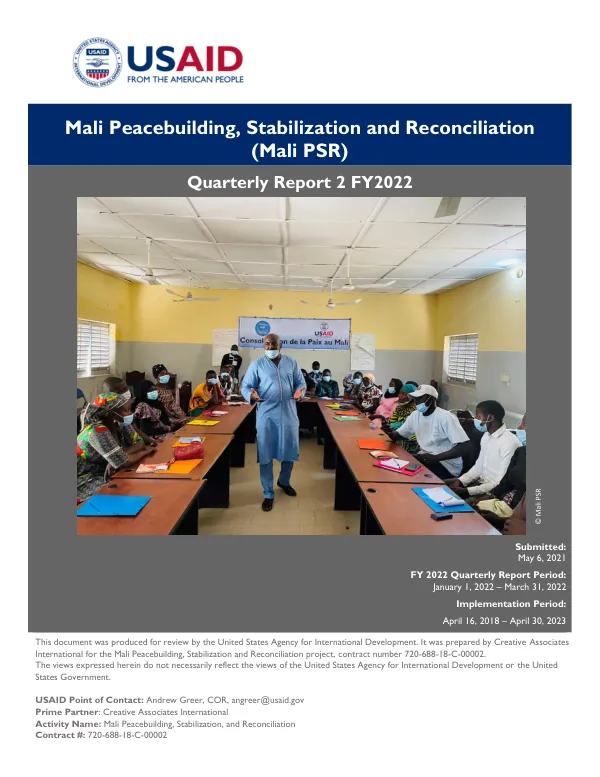
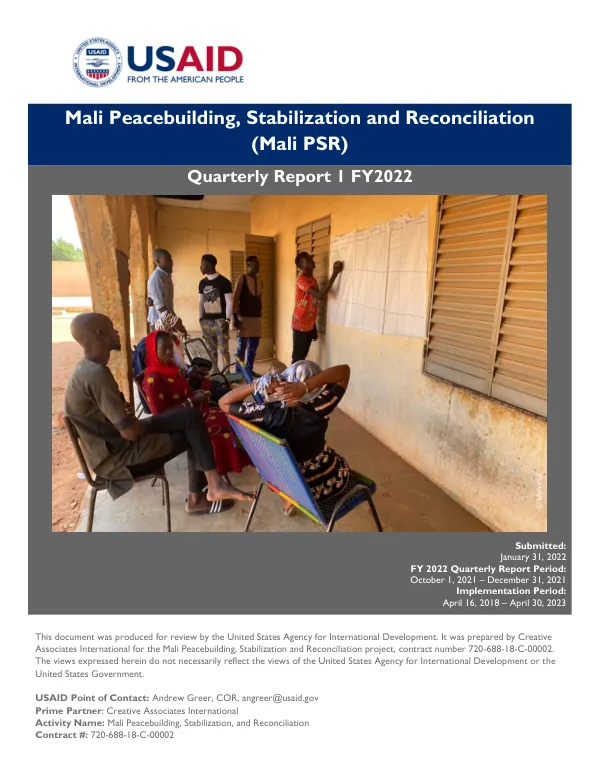
CREATIVE ASSOCIATES INTERNATIONAL INC.
SCOPING STUDY ON OBSTACLES TO REINTEGRATION AND RECONCILIATION IN MALI
The broad goal of our scoping work has been to identify the obstacles to reintegration and reconciliation in conflict-affected areas in Mali.
2021 · 29 pages
Sign in to readA free account is required to download.
Abstract
This involves a review of evidence from programming undertaken in analogous settings to identify potentially promising interventions that might be launched in Mali to facilitate peacebuilding, stabilization, and a return to normalcy. The regions of Mopti, Ségou, and Gao in Mali offer a broad variety of community-level conditions, including ongoing conflict, lawlessness, and post-conflict stability. Some communities have experienced large-scale population displacements, while others have seen relatively few people forced to leave their homes. Social divisions along lines of ethnicity, livelihood, or intensity of religious outlooks often contribute to conflict and affect the way community members view those who have left or returned. In choosing problems and community types to focus on, we consider several factors. First, we aim to avoid areas where conflict remains ongoing, as this would pose a risk to project staff and community residents. Second, we prioritize interventions that are likely to be effective in fostering reconciliation and reintegration, based on insights from focus groups and literature reviews. Third, we seek to select communities where the proposed interventions align with the expertise and capacity of the implementing partner, Creative Associates. Our analysis suggests that community-based interventions are best implemented by partners with experience and capacity in this area. We propose to focus on locations where the appropriate interventions are within Creative Associates' wheelhouse, and where experience working in these communities is an advantage. This approach will enable us to subject our programming choices to rigorous testing and evaluation, which may involve including or withholding interventions that are predicted to be weak or ineffective. The typology and intervention matrix presented in Appendix B provide a framework for understanding the complex relationships between community-level conditions, community types, and potential interventions. This matrix highlights the need for a nuanced and context-specific approach to reintegration and reconciliation efforts in Mali. The presence of ongoing conflict, lawlessness, or post-conflict stability in different regions of Mali creates distinct challenges for reintegration and reconciliation efforts. In some areas, interventions that focus on addressing the root causes of conflict, such as social divisions and economic disparities, may be more effective. In other areas, interventions that prioritize community-based initiatives, such as economic support and social services, may be more suitable. Ultimately, our goal is to identify the most effective and sustainable interventions that can be implemented in Mali to promote peacebuilding, stabilization, and a return to normalcy. By prioritizing community-based approaches and rigorous testing and evaluation, we aim to develop a comprehensive and context-specific strategy for reintegration and reconciliation in Mali.