USAID DEC
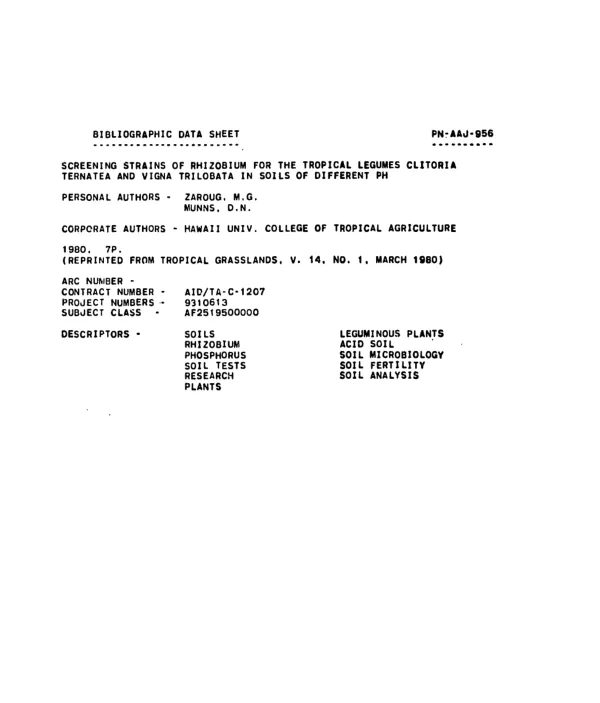
SCREENING STRAINS OF RHIZOBIUM FOR THE TROPICAL LEGUMES CLITORIA TERNATEA AND VIGNA TRILOBATA IN SOILS OF DIFFERENT PH
Sign inUNIVERSITY OF HAWAII AT MANOA. COLLEGE OF TROPICAL AGRICULTURE AND HUMAN RESOURCES
SCREENING STRAINS OF RHIZOBIUM FOR THE TROPICAL LEGUMES CLITORIA TERNATEA AND VIGNA TRILOBATA IN SOILS OF DIFFERENT PH
The success of phillipesara (Vigna trilobata) and clitoria (Clitoria ternatea), two potentially important irrigated forage legumes in the Sudan, will depend on the presence of Rhizobium strains able to persist and nodulate effectively in soils of varying degrees of acidity.
ZAROUG, M. G.; MUNNS, D. N. · 1970
Sign in to readA free account is required to download.
Abstract
This report describes tests of Rhizobium strains with phillipesara and clitoria grown in a neutral sandy soil and performance of selected strains with phillipesara in an acid soil. Eleven strains for clitoria and 13 for phillipesara were tested with uninoculated and plus nitrogen checks. Treatments were replicated three times in a completely random design. Large differences were found in the effectiveness of clitoria strains. Four notably successful strains (TAL 173, 29B2, TAL 200, and TAL 305) exceeded the nitrogen-treated plants in dry matter production, but the difference was significant for TAL 173 only. Nitrogen content also varied between the different treatments with five strains (173, 29B2, 305, 200, and 169) showing nitrogen yields not significantly less than the nitrogen-treated plants. Nitrogen yield, plant color, and dry weight yield gave similar rankings of strain effectiveness. Effectiveness bore little relationship to nodule number, weight, or distribution. Large differences were found in nitrogen content and dry matter yield among phillipesara. Effectiveness ranked similarly according to plant dry matter, nitrogen content or color, by contrast to clitoria whose nodule fresh weight correlated with nitrogen content significantly and plant yield correlated significantly with both nodule fresh weight and number. Nitrogen yield of the plus N plants exceeded that from any of the inoculants. While all strains of Rhizobium nodulated phillipesara in Goldridge acid soil (except CB1024 which failed completely), no strain gave plant yields as high as the N-control treatment. Liming the Goldridge soil reduced nodulation and also reduced growth in most treatments including the N-control treatment. There was no significant effect of treatment on ethylene formed. A list of 10 references (1954-77) is appended.