MERCY CORPS INTERNATIONAL
SECOND QUARTERLY REPORT FOR USG FY 2011
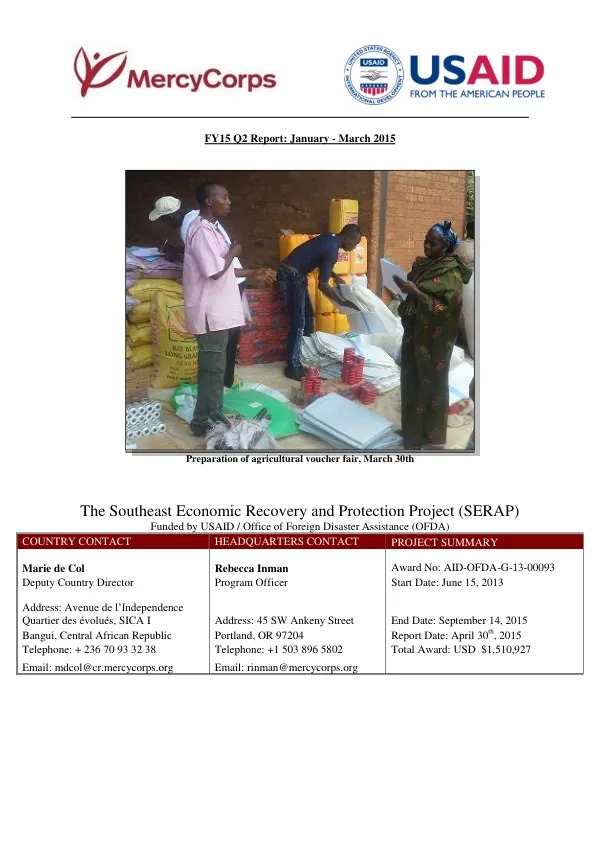
The Southeast Economic Recovery and Protection Project (SERAP) was initiated in June 2013 to address the growing protection and relief needs of conflict-affected communities in southeastern Central African Republic (CAR).
2015 · 9 pages
Sign in to readA free account is required to download.
Abstract
The project's primary objective is to enhance community resilience, increase food security, and strengthen the protective environment for children, women, and men affected by conflict in the Mbomou prefecture. The program focuses on child protection, agriculture, food security, and socio-economic support. During the reporting period, the project achieved significant milestones. A total of 2,500 beneficiaries started training and received agricultural products, including seeds, tools, and food kits, via a voucher system that sourced products locally. All 61 Resilience Groups in both project locations were trained in Village Savings and Loan (VSLA) methodology. The gender-based violence (GBV) prevention strategy of the Listening Center was continued, with the start of training on conflict mediation for couples and discussion groups with men on topics related to GBV cases. The Listening Centers in both locations responded to 222 GBV- and conflict-related cases during the reporting period. Cases were provided with psychosocial support and medical referrals as needed. In Bangassou, physical and emotional aggression remained the most recurrent types of GBV registered at the Listening Center, with the majority directly related to denial of resources to women upon informing their intimate partners of a pregnancy. The staff at the Listening Center organized group discussions with men and women to analyze the root causes and identify effective prevention methods. The project also engaged men in the community to act as leaders of change in the prevention of GBV and increased awareness of the services provided at the Listening Center. Children, especially girls, remained the principal target group in rape cases, with neighbors or family members as main actors in many cases. The program protection and psychosocial staff organized monthly trainings on GBV, including legislation in force for state and local authorities, reaching 109 people. The project's performance summary indicates that 27,341 beneficiaries were reached during the reporting period, with 1,413 internally displaced persons (IDPs) among them. The cumulative number of beneficiaries reached is 117,486, with 12,119 IDPs. The project's expected results include providing protection services to 20,000 vulnerable people, restoring assets for 4,000 vulnerable people, improving agriculture livelihoods and income generation opportunities for 2,500 vulnerable people, and collecting surveillance information to provide timely and rigorous early warning and vulnerability information for 93,457 people living in the Mbomou prefecture. The project's geographic focus is on the Mbomou prefecture in southeastern CAR, with a particular emphasis on the towns of Rafai, Agoumar, Selim, Dembia, Geurekindo, and surrounding villages. The project's timeframes are from June 15, 2013, to September 14, 2015, with a total award of USD 1,510,927 from the USAID/Office of Foreign Disaster Assistance (OFDA).
Related documents