USAID DEC
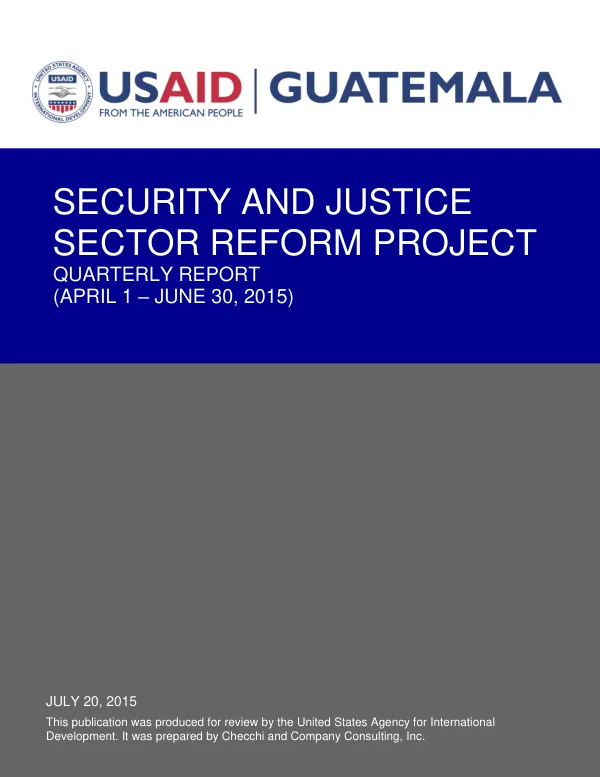
Security and Justice Sector Reform Project Quarterly Report (April 1 – June 30, 2015)
Sign inCHECCHI AND COMPANY, CONSULTING, INC.
Security and Justice Sector Reform Project Quarterly Report (April 1 – June 30, 2015)
Guatemala is experiencing a unique moment in its recent history.
2015 · 74 pages
Sign in to readA free account is required to download.
Abstract
In May and June, the Public Ministry and the International Commission against Impunity in Guatemala (CICIG) unveiled corruption investigations involving senior officials in the executive branch. The cases revealed several organized criminal networks within the Tax Authority with the possible participation of several judges. Protests took to the streets in a series of massive peaceful demonstrations demanding the resignation of the officials involved, as well as the initiation of criminal investigations and legal reforms to change the political and justice systems in an effort to prevent future misconduct. The resignation of Vice President Ingrid Roxana Baldetti Elias and other senior executive branch officials, such as Minister of Governance Mauricio López Bonilla and Vice Minister of Security Edy Juarez, among others, as well as the initiation of impeachment actions against high-level government officials, including President Otto Fernando Perez Molina, have generated institutional tension on the issues of security and justice in Guatemala. General elections are scheduled to be held in September, further creating a tense climate within the executive branch, legislature, Judicial Branch, and Public Ministry, with each struggling to carry out their respective functions. Despite this critical environment, the Security and Justice Sector Reform Project (SJSRP or Project) has made progress in advancing its program. The project's main goal is to strengthen the capacity of the state to manage security and justice administration, as well as to provide security and justice for citizens. The project's progress is reflected in the implementation of various activities and interventions aimed at achieving these goals. One of the key areas of focus for the project is the strengthening of social communication departments and units within Security and Justice Sector Institutions (SJSIs). This includes the provision of training and technical assistance to enhance the capacity of these departments to effectively communicate with the public and other stakeholders. Additionally, the project has supported the development of a Rapid Response Fund (RRF) to provide timely and effective responses to emerging security and justice challenges. The project has also made significant progress in promoting gender integration within the security and justice sector. This includes the provision of training and technical assistance to enhance the capacity of SJSIs to address gender-based violence and promote gender equity. The project has also supported the development of policies and procedures to prevent and respond to gender-based violence. In terms of monitoring and evaluation, the project has established a robust system to track progress and identify areas for improvement. This includes the use of indicators to measure the project's impact and effectiveness. The project has also established a system for reporting on key issues and administrative matters, which provides valuable insights into the project's progress and challenges. Overall, the Security and Justice Sector Reform Project has made significant progress in advancing its program, despite the challenging environment in Guatemala. The project's focus on strengthening the capacity of the state to manage security and justice administration, as well as to provide security and justice for citizens, is critical to addressing the country's security and justice challenges.