USAID
Seed Germination Cabinet Fact Sheet
Seed viability testing is a crucial step in crop management, allowing farmers to assess the quality of their seeds before planting.
2011 · 1 pages
Sign in to readA free account is required to download.
Abstract
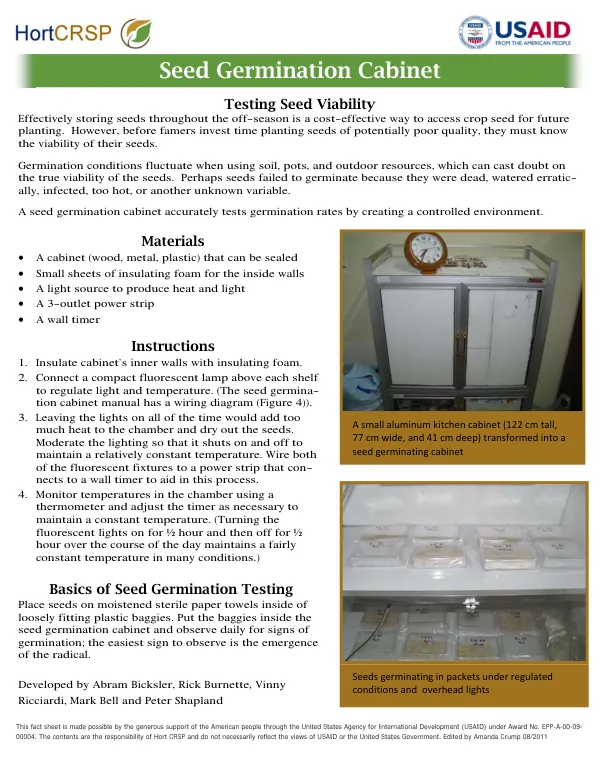
This process involves creating a controlled environment to simulate germination conditions, eliminating variables that can affect seed germination. A seed germination cabinet is a cost-effective tool for testing seed viability, providing a consistent and reliable method for evaluating seed quality. The cabinet consists of a sealed enclosure, typically made of wood, metal, or plastic, with insulating foam lining the inner walls to maintain a stable temperature. A light source, such as a compact fluorescent lamp, is used to provide heat and light, while a 3-outlet power strip and wall timer allow for controlled lighting and temperature regulation. The cabinet's dimensions can vary, but a small aluminum kitchen cabinet (122 cm tall, 77 cm wide, and 41 cm deep) can be transformed into a seed germinating cabinet. To set up the seed germination cabinet, insulate the inner walls with insulating foam, and connect a compact fluorescent lamp above each shelf to regulate light and temperature. The lights should be programmed to turn on and off to maintain a relatively constant temperature, with a wiring diagram available in the seed germination cabinet manual. Monitoring temperatures in the chamber using a thermometer is essential, and adjustments to the timer may be necessary to maintain a consistent temperature. The process of seed germination testing involves placing seeds on moistened sterile paper towels inside loosely fitting plastic baggies, which are then placed inside the seed germination cabinet. Observing daily for signs of germination, such as the emergence of the radical, allows for accurate assessment of seed viability. This method eliminates variables that can affect seed germination, such as soil, pots, and outdoor resources, providing a reliable and consistent method for evaluating seed quality. The seed germination cabinet has been developed by a team of experts, including Abram Bicksler, Rick Burnette, Vinny Ricciardi, Mark Bell, and Peter Shapland. This tool has been made possible by the generous support of the American people through the United States Agency for International Development (USAID) under Award No. EPP-A-00-09-00004. The contents of this fact sheet are the responsibility of Hort CRSP and do not necessarily reflect the views of USAID or the United States Government.
Related documents