USAID. MISSION TO HAITI
Seed production and multiplication
Project to develop a sustainable system for producing and multiplying seeds for food crops in southern Haiti.
1992
Sign in to readA free account is required to download.
Abstract
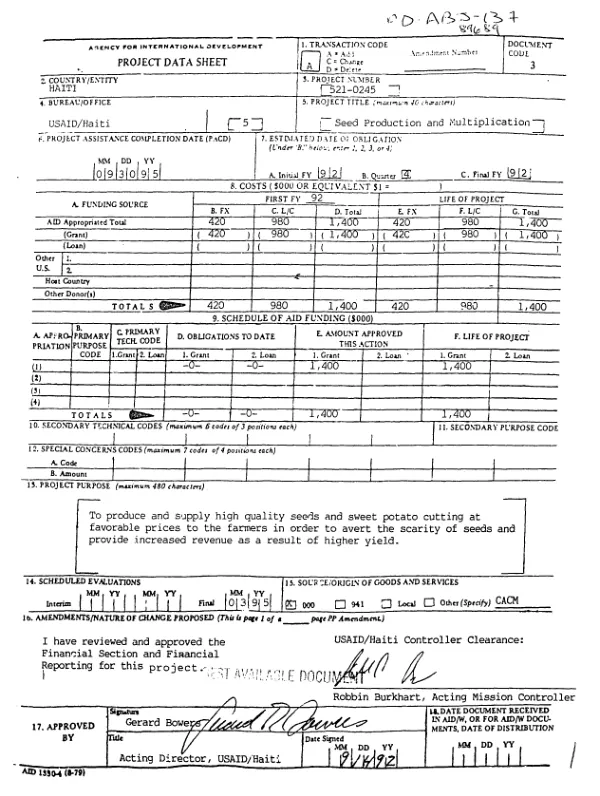
The project, to be implemented by the Organization for the Rehabilitation of the Environment (ORE), a Haitian NGO, will multiply both basic and commercial seed; expand seed drying, handling, and storage facilities; distribute seed commercially; and provide TA and training to farmers and seed producer groups. ORE will continue its ongoing program of selecting and genetically improving seed materials, and make the basic seeds (which are used to produce commercial seeds) available to seed producers; this will permit a rapid improvement in the germplasm stocks used as seeds for staple crop production throughout the country. The production of some 30 MTs of basic seeds is targeted. To increase the production of major staple crops and increase farmer revenues in the present agricultural crisis, ORE will produce 600 MTs of high-quality, high-yielding commercial seed, specifically, 400 MTs of corn, 160 of sorghum, 40 of black beans, and 4 million sweet potato cuttings. The seed will be sold to farmers through ORE"s existing distribution network in the south and through participating NGOs in the south. During the first year the seeds will be sold at net product cost price without overhead or equipment charges. Later, prices will be raised to cover full costs and allow the activity to be self-sustained; funds from the sale of seeds will be used to continue seed production on a permanent basis. It is estimated that more than 24,000 farmers will plant the seeds on over 36,000 ha. ORE will also expand its Camp Perrin operation to process and store the increased quantity of seed, and will train commercial seed farmers, farmer groups, and NGOs in production, processing, and storage technologies.
Related documents