USAID. BUR. FOR SCIENCE AND TECHNOLOGY. OFC. OF AGRICULTURE
Seed program and industry development : improved seed production and utilization
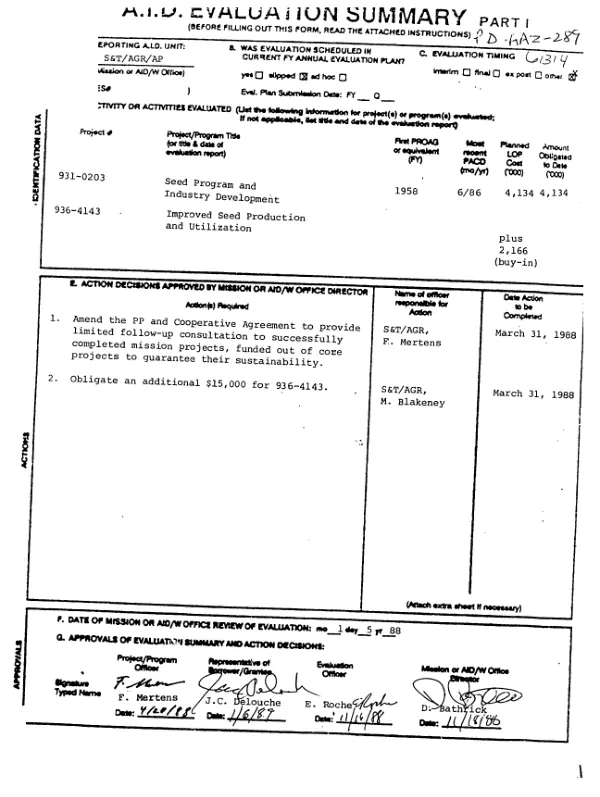
Summarizes impact evaluation (PD-AAZ-005) of a project to assist developing countries with the development of storage, processing, and handling of seeds.
1989
Sign in to readA free account is required to download.
Abstract
The project has been implemented by Mississippi State University (MSU) as a centrally funded project with the Bureau for Science and Technology since 1958. Since 1986, the project has concentrated on research and TA; the latter has been provided only if funded by Missions through the Basic Ordering Agreement. The major findings were as follows. (1) The impact of the project"s assistance and training at the Centro Internacional de Agricultura Tropical (CIAT) and in the countries of Niger, Honduras, Brazil, and Thailand has been notable. In each of the last three countries, an effective, profitable, and growing private seed industry has been established. (2) Training has strongly influenced the initiation of seed programs in the LDC"s. (3) MSU"s research has made a substantial contribution to drying and storing seed in the humid tropics. (4) A private seed industry was developed in all of the seed projects in which profitable opportunities were available. (5) The project"s cost of services to LDC"s has been low compared with other projects and greater amounts of total funding have been allocated to TA. (6) The TA provided by MSU is of the highest quality. Several lessons were learned. (1) Seed programs need to consider the role of private enterprise and public service; both are needed to assure a well-rounded program. (2) Trained staff are essential to project success, as is an ongoing agricultural research program dedicated to providing improved crop varieties. (3) Continuity and integration into on-going institutional research programs significantly improves the quality of services provided to A.I.D. by outside organizations and so does the use of permanent tenured staff. (4) Wide support by the LDC government is helpful to the establishment of a viable seed program. (5) IARC"s can be excellent locations for regional training. (6) Missions must properly sequence proposed assistance efforts to asssure conditions favorable to project success. (7) Follow-on activities after project completion can be important to successful institutionalization programs. (Author abstract, modified)